September 21, 2026 12:24 am (IST)

Follow us:


UN urges Morocco to expedite pending laws
New York, May 30 (IBNS): Morocco has made great strides towards the better promotion and protection of human rights, United Nations High Commissioner Navi Pillay said at the end of her first official visit to the country, but urged officials to approve pending draft laws and more robustly implement and enforce new legislation.
“Many of the promising protections under the Constitution have yet to be translated into reality for the people of Morocco,” Pillay told journalists at the end of a three-day visit which included meetings with King Mohamed VI and Prime Minister Abdelilah Benkirane, other key officials, as well as women judges and members of civil society.
The High Commissioner praised the establishment in 2004 of the Equity and Reconciliation Commission to probe past human rights violations which has served as a “catalyst for many of the wide-ranging human rights reforms that have taken place since.” These include the creation of the 2011 Constitution, and the strengthening of the National Council for Human Rights (CNDH) and the Ombudsman.
However, Pillay noted, several key reforms remain pending in the executive or legislative arenas. These include a package of draft laws on gender equality and gender-based violence, on military justice and on judicial reform which she urged to be swiftly presented in parliament. She also called for the adoption of a national plan for democracy and human rights, formulated by the CNDH more than two years ago, and the passing of a draft law on the press.
“In all of these areas there are high expectations about the positive impact of reforms, but these cannot be met until the laws are promulgated,” Pillay cautioned.
Recalling recent concerns from the Special Rapporteur on Torture, who visited Morocco and Western Sahara in 2012, and the Working Group on Arbitrary Detention, which visited in December 2013, Pillay said King Mohamed had informed her that “he will not tolerate torture, although he could not rule out that there are isolated cases.”
Work also remains to be done to engender the culture of respect for human rights among all institutions of the State, in Morocco and Western Sahara, including among judicial officers, law enforcement and corrections officers and administrative officials at the national, regional and local levels, the High Commissioner said.
She encouraged the Government to ensure that human rights and fundamental freedoms are equally protected in Morocco and in Western Sahara, the territory which has been in dispute since Spain withdrew in 1975.
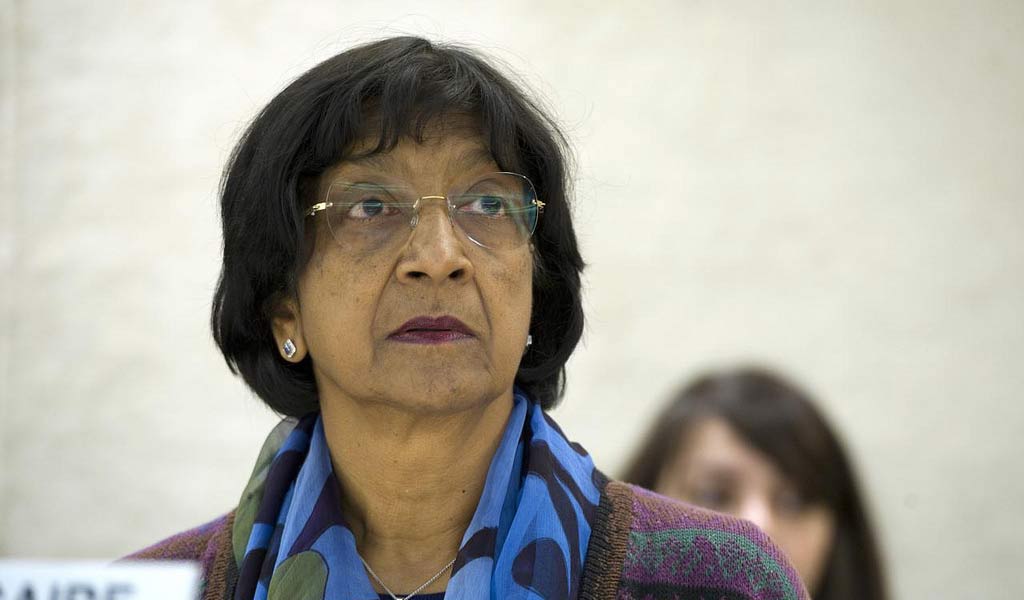
(High Commissioner for Human Rights Navi Pillay. Photo: Violaine Martin)
Support Our Journalism
We cannot do without you.. your contribution supports unbiased journalism
IBNS is not driven by any ism- not wokeism, not racism, not skewed secularism, not hyper right-wing or left liberal ideals, nor by any hardline religious beliefs or hyper nationalism. We want to serve you good old objective news, as they are. We do not judge or preach. We let people decide for themselves. We only try to present factual and well-sourced news.
Support objective journalism for a small contribution.



Latest Headlines
Italy PM Meloni announces big school plan: Burqa, hijab ban and cap on foreign students
Sun, Sep 20 2026
North Korea fires two missiles toward East Sea, South Korea confirms
Sun, Sep 20 2026
Houthis claim Saudi F-15 shot down as Mecca drone row escalates
Wed, Sep 16 2026