October 24, 2026 08:50 pm (IST)

Follow us:


UN urges less military spending, more investment in development
New York, Apr 15 (IBNS): Marking the Global Day of Action on Military Spending, the United Nations independent expert on the promotion of a democratic and equitable international order called on all governments to boost transparency and cuts in military expenditures, and increase investments in nutrition, health, environmental protection and other major sustainable development challenges.
“Every democracy must involve civil society in the process of establishing budgets, and all sectors of society must be consulted to determine what the real priorities of the population are,” Special Rapporteur Alfred de Zayas said in a statement. “Lobbies, including military contractors and other representatives of the military-industrial complex, must not be allowed to hijack these priorities to the detriment of the population’s real needs.”
The expert urged world parliaments to implement the will of the people, based on representative opinion polling, and significantly reduce all military expenditures (arms production, military research, military bases abroad, surveillance of private citizens, ‘intelligence’-gathering, or overt and covert military operations).
“Tax revenue must be reoriented toward the promotion of civil, political, economic, social and cultural rights, for research into sustainable sources of energy and for the promotion of sustainable development,” de Zayas stressed.
According to the Stockholm International Peace Research Institute, global military spending levels are at an all-time high, reaching a total of USD 1.75 trillion in 2012, a number that de Zayas says constitutes “an unconscionable use of resources.”
“In a world where millions of human beings live in extreme poverty, die of malnutrition and lack medical care, where pandemics continue to kill, it is imperative to pursue good faith disarmament negotiations and to shift budgets away from weapons production, war-mongering, and surveillance of private persons, and devote available resources to address global challenges including humanitarian relief, environmental protection, climate change mitigation and adaptation, prevention of pandemics, and the development of a green economy,” he said.
De Zayas highlighted that such a shift in States’ spending habits is key to achieving the UN post-2015 development agenda.
“I am surprised that in the current context of global socio-economic crisis, few have voiced indignation regarding the disproportionate levels of military spending. The place to exercise austerity is in wasteful military expenditures, not in social protection,” he insisted.
The Special Rapporteur urged governments to “considerably reduce funds allocated to the military, not only as a disarmament issue, but also as a potential contributor to social and environmental protection,” and called for “the holding of referenda on this issue worldwide.”
Estimating that a 10 per cent annual reduction in military expenditures would be “reasonable,” de Zayas also encouraged all States to contribute to the UN’s annual Report on Military Expenditures by submitting complete data on national defence budgets.
Independent experts or special rapporteurs are appointed by the UN Human Rights Council in Geneva to examine and report back on a country situation or a specific human rights theme. The positions are honorary and the experts are not UN staff, nor are they paid for their work.
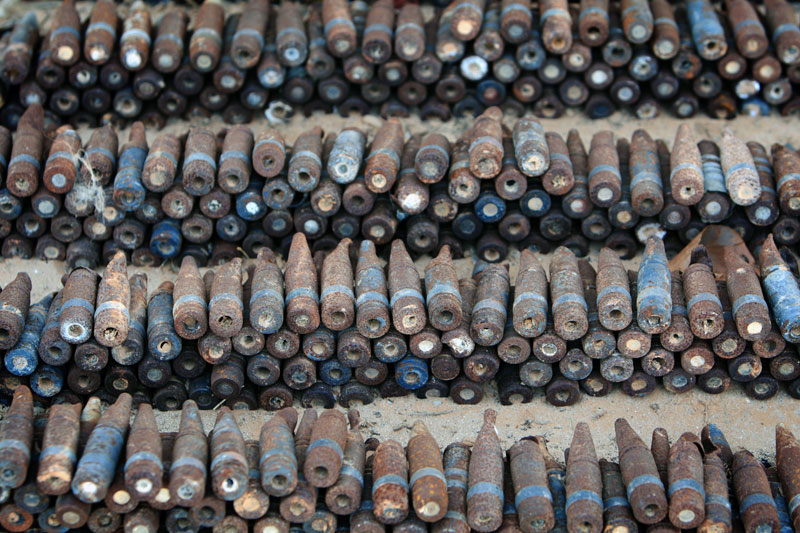
(Weapons collected in Libya to prevent arms proliferation. Photo: Giovanni Diffidenti)
#Global Day of Action on Military Spending
# United nations
# military expenditures
# investment in development
Support Our Journalism
We cannot do without you.. your contribution supports unbiased journalism
IBNS is not driven by any ism- not wokeism, not racism, not skewed secularism, not hyper right-wing or left liberal ideals, nor by any hardline religious beliefs or hyper nationalism. We want to serve you good old objective news, as they are. We do not judge or preach. We let people decide for themselves. We only try to present factual and well-sourced news.
Support objective journalism for a small contribution.



Latest Headlines
‘Impossible without my intervention’: Melania Trump announces Russia-Ukraine ceasefire in Oleshky
Sat, Oct 24 2026
Meghan Markle ‘deeply distressed’ over child sexual abuse image claims against her father
Sat, Oct 24 2026
Deadly mid-air collision: Four pilots killed as two military aircraft crash in Philippines
Sat, Oct 24 2026
Eiffel Tower women staff row: BAPS monk blames ‘miscommunication’, denies delegation's role
Fri, Oct 23 2026
Dammam airport attack: Indian killed, two compatriots injured as Saudi Arabia faces fresh strikes
Thu, Oct 22 2026
‘Among others’: Macron takes swipe at Trump over France unrest, calls foreign leaders’ remarks ‘stupid’
Thu, Oct 22 2026
Australian MP Helen Haines has both legs amputated after car attack described as political violence
Wed, Oct 21 2026