


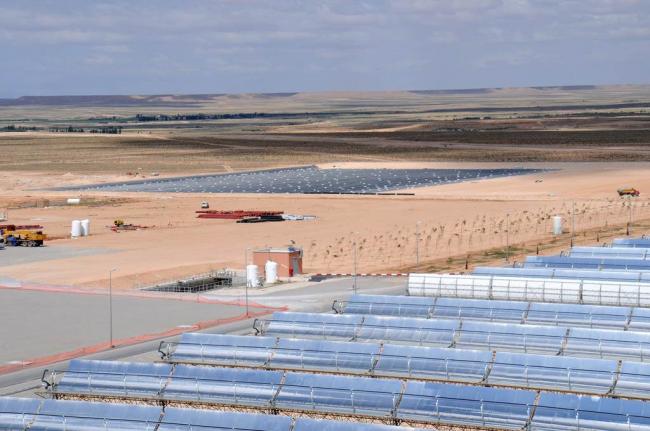
UN report assesses ‘huge benefits’ and challenges of green energy revolution
“We are on the right track. We know that cleaning up the air we breathe gives rise to huge benefits to both human and environmental health, and we know, too, that low-carbon energy efficiency technologies can help us reduce damaging climate change,” said Erik Solheim, Executive Director of the UN Environment Programme (UNEP) in a press release on the new report.
At the same time, the UN Environment chief said: "[We are] also clear on the need for greater action on building a circular economy that cuts waste, and on production innovations that could also create new, green jobs.”
Entitled “Green Technology Choices: The Environmental and Resource Implications of Low-Carbon Technologies,” the report, released on Friday at the Vienna Energy Forum, was compiled by a group of eminent experts in natural resource management hosted by UN Environment.
The panel examined eight energy efficiency technologies and 36 sub-technologies across buildings, industry and transportation and provided a global assessment of the benefits, risks and trade-offs encountered when energy efficiency technologies are deployed alongside low-carbon electricity supply technologies.
Among its findings, the report notes that research confirms that demand-side technologies reduce greenhouse gas emissions, as well as many other environmental impacts. However, the magnitude of those improvements varies widely among technologies and regions.
Indeed, in some cases, say the experts, demand-side technologies may increase resource consumption and even greenhouse gas emissions. Therefore, it is crucial to understand where, when, and with which technology investment should be placed to maximize benefits.
The report compared two scenarios – one for a global temperature rise of 6 degrees Celsius and the other assuming that the global target of 2 degrees Celsius above pre-industrial levels is achieved.
Key findings of the analysis include:
Under the 2-degree scenario, low-carbon energy production and energy efficiency technologies have the potential to cut about 25 billion tonnes a year of greenhouse gas emissions by 2050, which is about 34 per cent lower than the emissions under business-as-usual.
under the 2-degree scenario more than 17 million tonnes per year of particulate matter and over 3 billion tonnes of emissions toxic to humans could be avoided through the use of low-carbon energy technologies
Low-carbon energy technologies could save more than 200 billion cubic metres of water a year and nearly 150,000 square kilometres of land occupation by 2050.
Transformation to low-carbon energy technologies will require over 600 million tonnes of metal resources by 2050 for additional infrastructure and wiring needs.
Photo: World Bank/Dana Smillie
Source: www.justearthnews.com
Support Our Journalism
We cannot do without you.. your contribution supports unbiased journalism
IBNS is not driven by any ism- not wokeism, not racism, not skewed secularism, not hyper right-wing or left liberal ideals, nor by any hardline religious beliefs or hyper nationalism. We want to serve you good old objective news, as they are. We do not judge or preach. We let people decide for themselves. We only try to present factual and well-sourced news.
Support objective journalism for a small contribution.


