


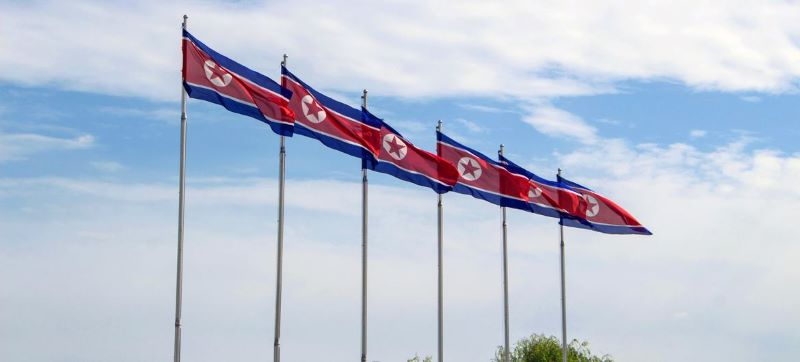
 North Korea
UN official asks North Korea to halt missile activities and return to path of dialogue
The Democratic People’s Republic of Korea’s (DPRK) repeated launches using ballistic missile technology not only violate Security Council resolutions but also pose a serious risk to aviation and maritime traffic, a senior UN official said on Friday.
At 10:45 PM local time on 27 May, the DPRK, also known as North Korea, conducted what it described as “the launch of reconnaissance satellite Malligyong-1-1 aboard the new-type satellite carrier rocket” from the Sohae Satellite Launching Station.
According to the DPRK, the launch failed “due to the air blast of the new-type satellite carrier rocket during the first-stage flight”. It attributed the failure to the “reliability” of the newly developed liquid oxygen-petroleum engine, Khaled Khiari, Assistant Secretary-General in the Department of Political and Peacebuilding Affairs (DPPA), told ambassadors at the Security Council.
Developing a military reconnaissance satellite is part of North Korea’s five-year military development plan, unveiled in January 2021.
Since 2022, the country has significantly increased its missile launch activities, including more than 100 launches using ballistic missile technology, in violation of relevant Security Council resolutions. This year alone, the DPRK has launched two intermediate-range solid-fuelled ballistic missiles in January and April.
Breach of Security Council prohibitions
Ahead of the latest launch, DPRK issued a notification to the Japanese Coast Guard but did not notify the specialised UN agencies – International Civil Aviation Organization (ICAO) or the International Telecommunications Union (ITU).
“The DPRK’s unannounced launches represent a serious risk to international civil aviation and maritime traffic,” he warned.
Assistant Secretary-General Khiari briefing the Security Council.
He also underscored the need for the country to comply with its international obligations.
“Sovereign States have the right to benefit from peaceful space activities,” he said.
“However, Security Council resolutions expressly prohibit the DPRK from conducting any launches using ballistic missile technology.”
On 28 May, the UN Secretary-General strongly condemned the attempted launch, reiterating the call for the DPRK to return to dialogue to achieve sustainable peace and complete denuclearization of the Korean Peninsula.
Create space for dialogue
Mr. Khiari highlighted the urgent need for practical measures to reduce tensions and create space for diplomatic avenues.
“The Secretary-General has emphasised the importance of re-establishing communication channels, particularly between military entities. Exercising maximum restraint is critical to avoid unintended escalation,” he said.
He also urged all Member States, and members of the Security Council, to seek unity, and for all parties to create an environment conducive to dialogue and cooperation.
“At this particularly difficult moment in securing global peace and security, it is imperative to de-escalate the rising tensions on the Korean Peninsula,” he said.
UN ready to assist
In addition to addressing the security concerns, Khiari noted that the United Nations and its partners are ready to assist the DPRK in addressing the basic needs of its vulnerable populations.
With international travel to and from the DPRK increasing, he encouraged the authorities to facilitate the full return of the international community, including the United Nations Resident Coordinator and the UN Country Team.
“A collective return would enhance international support for the people of the DPRK and the implementation of the 2030 Agenda,” he concluded.
Support Our Journalism
We cannot do without you.. your contribution supports unbiased journalism
IBNS is not driven by any ism- not wokeism, not racism, not skewed secularism, not hyper right-wing or left liberal ideals, nor by any hardline religious beliefs or hyper nationalism. We want to serve you good old objective news, as they are. We do not judge or preach. We let people decide for themselves. We only try to present factual and well-sourced news.
Support objective journalism for a small contribution.


