


UN labour agency advocates policy changes to address rise in non-standard forms of employment
Non-standard forms of employment (NSFE) are not new, but are becoming more common throughout the world and include temporary work, part-time work, temporary agency work and subcontracting, self-employment, and disguised employment relationships.
“We need to make sure that all jobs provide workers with adequate and stable earnings, protection from occupational hazards, social protection, and the right to organize and bargain collectively and that employees know the identity of their employer,” said Deborah Greenfield, ILO Deputy Director for Policy, in a press release.
On the one hand, NSFE can provide access to the labour market and increased flexibility for workers and employers. But on the other, warns the ILO report, NSFE is associated with greater insecurities for workers. In countries where the practice is widespread, workers risk getting caught in a cycle of non-standard jobs and unemployment. It documents a 30 per cent wage gap between those working temporary jobs and standard workers who perform similar work.
The report, Non-standard employment around the world: Understanding challenges, shaping prospects confirms that in some instances, especially those where contractual arrangements have blurred the employment relationship, workers are unable to exercise their fundamental rights at work or gain access to social security benefits and proper training. Injury rates are also higher among those in NSFE.
These trends have unintended consequences for businesses.
“Short-term cost and flexibility gains from using NSFE may be outweighed by longer-term productivity losses. There is evidence that firms that use NSFE more tend to underinvest in training, both for temporary and permanent employees, as well as in productivity-enhancing technologies and innovation,” said Philip Marcadent, Chief of the ILO unit responsible for the report.
“Widespread use of NSFE may reinforce labour market segmentation and lead to greater volatility in employment, with consequences for economic stability. Research shows that temporary and on-call workers have more difficulty getting access to credit and housing, leading to delays in starting a family,” he added.
The report documents a number of different trends. In industrialized countries, part-time work falls into ‘very short hours,’ ‘on-call’ work, or ‘zero-hours’ contracts that have no minimum hour guarantee. These conditions are parallel with “casual work” in developing countries.
In the United States, 10 per cent of the workforce has irregular and on-call works schedules; those earning the least are most affected. In Bangladesh and India, almost two-thirds of wage employment is casual. One-third is casual in Mali and Zimbabwe. In Australia, where casual employment is a specific category, one in four employees is casual.
ILO advocates four policy recommendations to improve the quality of non-standard jobs:
Plug regulatory gaps, which includes policies to ensure equal treatment among workers, minimum guaranteed hours and limits to variations in work schedules, legislation and enforcement to address employment misclassification, addressing abuse, and assigning obligations and responsibilities in those arrangements involving multiple parties;
Strengthen collective bargaining by building the capacity of unions to represent workers in NSFE, ensuring all workers have access to freedom of association and collective bargaining rights, and extending collective agreements to cover all workers in a sector or occupational category;
Strengthen social protection by eliminating or lowering thresholds on minimum hours, earnings, or duration of employment and making systems more flexible in terms of benefits. Such changes should be complemented by universal policies that guarantee a basic level of social protection; and
Institute employment and social policies that support job creation and workers’ needs for training and family responsibilities such as childcare and elder care.
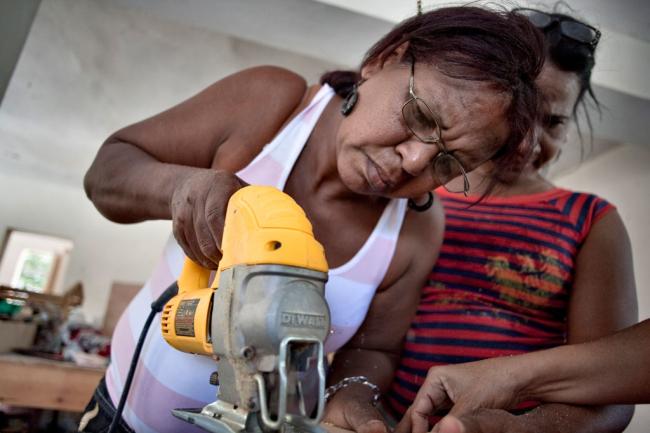
Photo: UNDP Dominican Republic
Source: www.justearthnews.com
Support Our Journalism
We cannot do without you.. your contribution supports unbiased journalism
IBNS is not driven by any ism- not wokeism, not racism, not skewed secularism, not hyper right-wing or left liberal ideals, nor by any hardline religious beliefs or hyper nationalism. We want to serve you good old objective news, as they are. We do not judge or preach. We let people decide for themselves. We only try to present factual and well-sourced news.
Support objective journalism for a small contribution.


