


UN, educators applaud Paramount's 'Selma,' chronicling Martin Luther King's campaign for voting equality
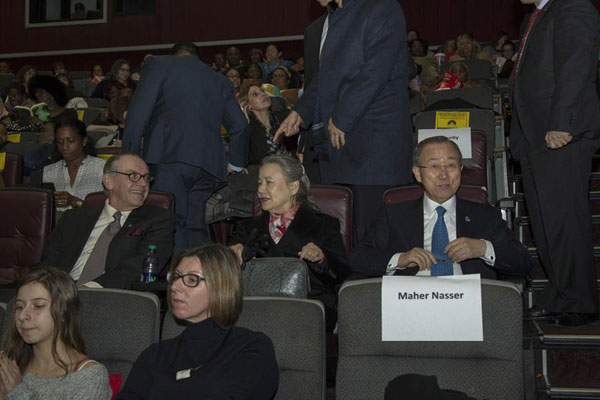
The film screening was attended by UN Secretary-General Ban Ki-Moon along with his wife, Madame Ban Soon-taek, Deputy -Secretary General Jan Eliasson, as well as the film’s director, Ava DuVernay.
Teachers, educators and students also attended the event as part of a programme that encourages public schools to teach the history of African-Americans and the African Diaspora. The event was co-organized by Paramount Pictures and the New Jersey Amistad Commission and the UN Department of Public Information (DPI), as part of its Remember Slavery programme.
Selma chronicles a string of historical events that led to the trailblazing marches, including the relationship between Dr. King and President Johnson and the struggle of ordinary citizens.
The film tells the story of the American south in the early 1960s, where black citizens applying to vote were repeatedly blocked by local registrars. By 1965, there were countries in Alabama, one of the worst cases in the south, where not a single black person had voted in any election for the previous 50 years – although African Americans were guaranteed the right to vote in 1870.
These events came to a head on 7 March, 1965, when marchers, led by civil rights leader Dr. Martin Luther King Jr., were assaulted by local and state troopers. Describing her process in directing the film, DuVernay said her goal was to humanize Dr. King so the audience could connect with him.
“I think if you see [Dr.] King as a man and not a myth, not a ‘mountaintop’ speech and not all of the things that we have constructed about him, and when you see him as a man it allows his greatness to be closer to us and allows us to touch that greatness and be that great.”
New Jersey 7th grader, Celeste Hopkin, told UN Radio that watching Selma inspired her.
“I think [the film] was very interesting especially because in school we don’t really learn a lot about Dr. Martin Luther King…It revealed a lot of things I didn’t even know about the march. I think it was very important because it showed all of the hardships they went through and what we have overcome in the past 50 years,” she said.
“Dr. Martin Luther King had hope and that pushed him…and now in Ferguson they need that hope and that guidance to overcome what has happened and not to have it revealed in violence but in a different way,” Celeste added, referring to the city in the US state of Missouri, where in August 2014, unarmed African American teenager Michael Brown was shot by a white police officer.
The Selma screening was part of the UN Remember Slavery programme, which mobilizes educators to teach about the causes and consequences of the transatlantic slave trade and to communicate the dangers of racism and prejudice.
“Selma reminds us of the issues and challenges that people of African descent have faced in the recent past and continue to face long after slavery has officially ended,” said Maher Nasser, the Acting head of DPI.
The UN General Assembly has proclaimed 2015-2024 as the International Decade for People of African Descent citing the need to strengthen cooperation in relation to the full enjoyment of all rights by people of African descent, and their full participation in all aspects of society.
“Films can serve as powerful educational tools to teach the young generations about the dangers of racism and prejudice,” added Nasser.
Secretary-General Ban Ki-moon (seated in second row with his wife Yoo Soon-taek and Deputy Secretary-General Jan Eliasson) attending an advanced screening of “Selma: One Dream Can Change the World.” UN Photo/Loey Felipe
Support Our Journalism
We cannot do without you.. your contribution supports unbiased journalism
IBNS is not driven by any ism- not wokeism, not racism, not skewed secularism, not hyper right-wing or left liberal ideals, nor by any hardline religious beliefs or hyper nationalism. We want to serve you good old objective news, as they are. We do not judge or preach. We let people decide for themselves. We only try to present factual and well-sourced news.
Support objective journalism for a small contribution.


