September 21, 2026 12:24 am (IST)

Follow us:


UN concerned over South Sudanese people fleeing fighting
New York, May 28 (IBNS): Some 70,000 more people have fled their homes in South Sudan since a May 9 agreement was signed to end the fighting that has ravaged the world's youngest nation for over six months, the United Nations refugee agency said on Tuesday.
“In South Sudan, the number of people fleeing fighting continues to rise almost three weeks on from a truce agreement,” Adrian Edwards, spokesperson for the UN High Commissioner for Refugees (UNHCR), said at a press briefing in Geneva.
Since the signing of the Cessation of Hostilities Agreement in Addis Ababa, Edwards said, the number of internally displaced people has grown by 46,000 people to 1,005,096. Over the same period, the number of South Sudanese refugees in Ethiopia, Kenya, Sudan and Uganda has risen by over 20,000 to 370,000 people.
South Sudan has been enmeshed in a crisis which began in mid-December 2013 as a political dispute between President Salva Kiir and his former deputy president, Riek Machar, who had been forced from office earlier that year.
The in-fighting has since erupted into a deadly conflict forcing tens of thousands of people to seek refuge at UN bases around the country. The political rivals signed an ‘Agreement to Resolve the Crisis’ last month with the aim of ending the violence.
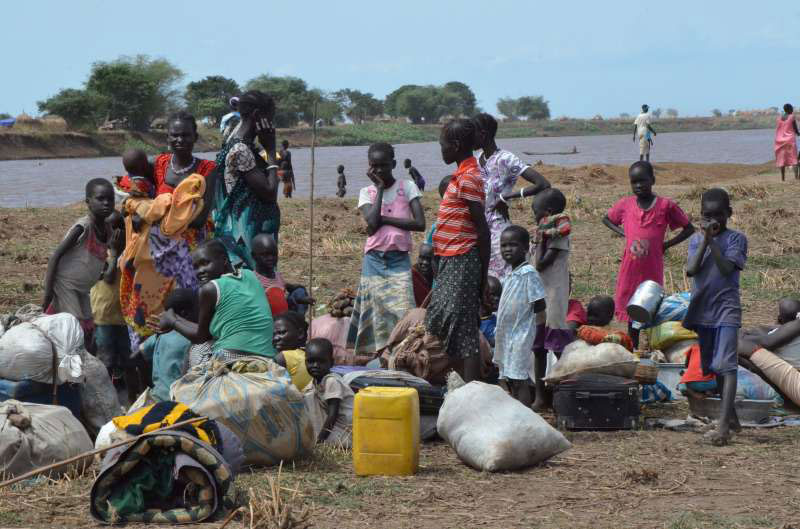
At Tuesday’s briefing, Edwards said that Ethiopia currently hosts the largest South Sudanese refugee population at 131,051 people, mostly women and children. Recent arrivals say they have fled fighting in neighbouring Jonglei and Upper Nile states, fearing attacks or lack of food.
To accommodate the refugees, UNHCR and the Ethiopian authorities have opened three new camps this year. “With an average of 1,000 South Sudanese arriving daily in Ethiopia, we have already started looking for additional land for a fourth camp,” Edwards said.
Commenting on those displaced within South Sudan in a press briefing in Juba on Tuesday, a spokesperson for the UN peacekeeping mission known as UNMISS said that as of on Tuesday between 75,000 and 80,000 civilians have sought safety in the Mission’s main protection sites.
Stressing that those sites were never meant to be a durable solution, the spokesperson reported that rain, along with clogged drains and congestion, have turned them into breeding grounds for water-borne diseases, including cholera.
The World Health Organization (WHO) said on Tuesday that it was working closely with its partners and the South Sudan Ministry of Health to stem the cholera outbreak in the country, where, the agency said, more than 514 cases have been reported so far.
(A group of displaced women and children rest on Ethiopian territory after crossing the Baro River from South Sudan. Photo: UNHCR/L.F. Godinho)
Support Our Journalism
We cannot do without you.. your contribution supports unbiased journalism
IBNS is not driven by any ism- not wokeism, not racism, not skewed secularism, not hyper right-wing or left liberal ideals, nor by any hardline religious beliefs or hyper nationalism. We want to serve you good old objective news, as they are. We do not judge or preach. We let people decide for themselves. We only try to present factual and well-sourced news.
Support objective journalism for a small contribution.



Latest Headlines
Italy PM Meloni announces big school plan: Burqa, hijab ban and cap on foreign students
Sun, Sep 20 2026
North Korea fires two missiles toward East Sea, South Korea confirms
Sun, Sep 20 2026
Houthis claim Saudi F-15 shot down as Mecca drone row escalates
Wed, Sep 16 2026