September 20, 2026 11:25 pm (IST)

Follow us:


UN concerned over people lacking proper social protection
New York, Jun 4 (IBNS): In the aftermath of the global economic crisis, more than 70 per cent of the world population is without proper social protections, the United Nations labour agency on Tuesday reported, urging governments to scale up investment in child and family benefits, pensions and other public expenditures.
“The global community agreed in 1948 that social security and health care for children, working age people who face unemployment or injury and older persons are a universal human right,” said Sandra Polaski, Deputy Director-General of the International Labour Organization (ILO).
“And yet in 2014 the promise of universal social protection remains unfilled for the large majority of the world’s population.”
As many as 122 governments are contracting public expenditures in 2014, of which 82 are developing countries, according to the findings of the World Social Protection Report 2014/15: Building economic recovery, inclusive development and social justice.
“The case for social protection is even more compelling in these times of economic uncertainty, low growth and increased inequality,” Polaski added, noting that it is also an issue that the international community should embrace prominently in the development agenda following the Millennium Development Goals deadline in 2015.
At the beginning of the 2008-2009 economic crisis, at least 48 high- and middle-income countries put in place stimulus packages totalling USD 2.4 trillion that devoted roughly a quarter to social protection measures.
This support “acted as an automatic stabilizer that helped the economies to regain balance and protected the unemployed and vulnerable from economic disaster in the countries where it was extended,” according to the report.
But from 2010 onwards, many governments reversed course and embarked prematurely on fiscal consolidation, despite the urgent need to continue supporting vulnerable populations and stabilizing consumption.
In the European Union, cuts in social protection have already contributed to increases in poverty which now affect 123 million people or 24 per cent of the population, many of whom are children, women, older persons and persons with disabilities, the ILO reported.
Meanwhile, some middle-income countries, such as China, are close to achieving universal pension coverage and have sharply increased minimum wages, and Brazil has accelerated the expansion of social protection coverage and minimum wages since 2009.
The report also shows that about 39 per cent of the world population lacks any affiliation to a health system or scheme. The number reaches more than 90 per cent in low-income countries.
The report also highlights the cases of Thailand and South Africa, which have achieved universal health coverage in just a few years, showing that it can be done.
“It is now a matter of political will to make it a reality. Modern society can afford to provide social protection,” Polaski stated.
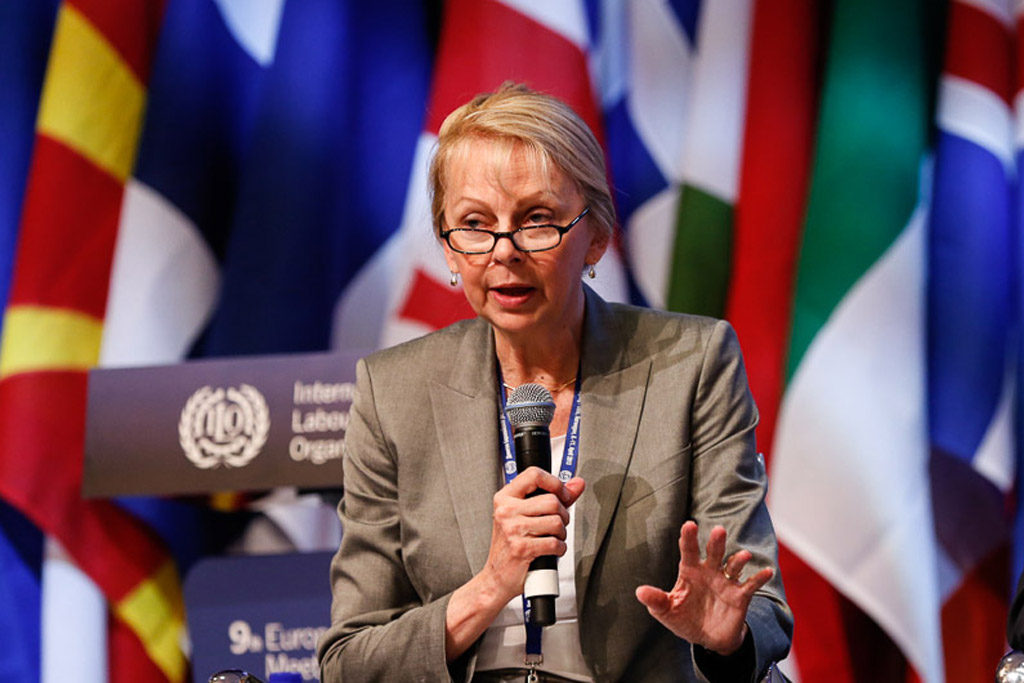
(ILO Deputy Director-General for Policy Sandra Polaski. Photo: ILO)
Support Our Journalism
We cannot do without you.. your contribution supports unbiased journalism
IBNS is not driven by any ism- not wokeism, not racism, not skewed secularism, not hyper right-wing or left liberal ideals, nor by any hardline religious beliefs or hyper nationalism. We want to serve you good old objective news, as they are. We do not judge or preach. We let people decide for themselves. We only try to present factual and well-sourced news.
Support objective journalism for a small contribution.



Latest Headlines