September 21, 2026 12:24 am (IST)

Follow us:


UN concerned over food security situation in Somalia
New York, Jun 3 (IBNS): The United Nations on Monday voiced increasing concern over the food security situation in Somalia, as food stocks from the previous harvest become depleted and prices continue to rise sharply, and the country experiences late rains and erratic weather patterns.
The situation is being exacerbated by conflict and inadequate funding for priority actions designed to address the needs of hard-hit communities, according to a new report by the Food and Agriculture Organization (FAO).
“The people of Somalia cannot afford to wait to see how the next harvest turns out. They need urgent support to improve their food security and maintain their livelihoods, most of which depend directly on agriculture,” said Luca Alinovi, acting Head of FAO’s Somalia Office and FAO Representative in Kenya.
FAO and its partners are urgently seeking USD 18 million to scale up rapid interventions to prevent and mitigate the further deterioration of the food security situation, the agency said in a news release.
A “weak” January harvest coupled with a delayed start to the 2014 gu season (April-June) have fuelled concerns for the food security situation. FAO noted that harvests were “well below average” in the central and southern areas of the country, following weeks of late and erratic rainfall, as well as flooding around rivers.
Lower stocks, coupled with the market and trade disruptions, led to double-digit increases in wholesale prices of maize and sorghum in some areas.
In the main producing areas of the south, April retail prices of maize and sorghum were as much as 60 and 80 per cent higher, respectively, than one year earlier, also due to the scaling back of humanitarian assistance operations.
The gu rains resumed in early May, but rains will need to continue through the end of June in order to prevent further deterioration of the food security situation in Somalia.
Conditions are expected to improve slightly in August and September when the harvest is ready for consumption, but the positive impact is likely to be moderate given the unfavourable prospects of the current season.
The number of people in need of humanitarian assistance in Somalia is currently estimated at about 860,000, including over 200,000 malnourished children under five years of age.
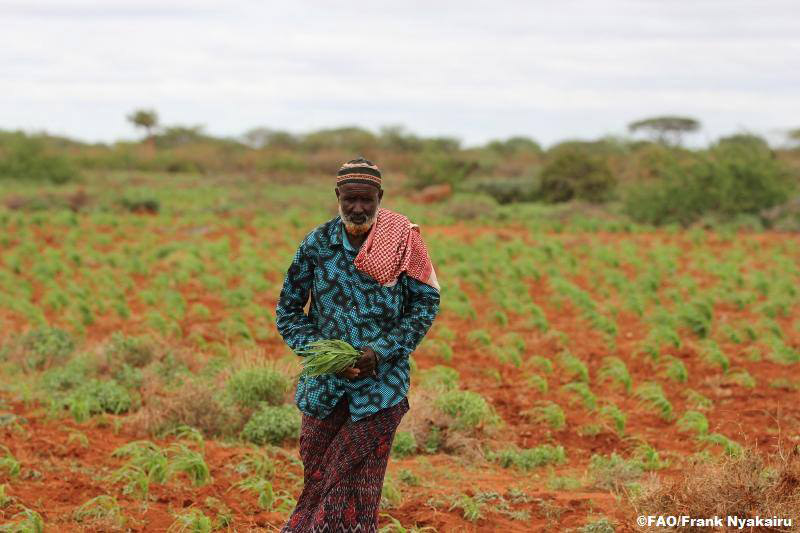
(Somalis need support in a wide range of activities, from cropping to livestock breeding and fisheries. Photo: FAO/Frank Nyakairu)
Support Our Journalism
We cannot do without you.. your contribution supports unbiased journalism
IBNS is not driven by any ism- not wokeism, not racism, not skewed secularism, not hyper right-wing or left liberal ideals, nor by any hardline religious beliefs or hyper nationalism. We want to serve you good old objective news, as they are. We do not judge or preach. We let people decide for themselves. We only try to present factual and well-sourced news.
Support objective journalism for a small contribution.



Latest Headlines
Italy PM Meloni announces big school plan: Burqa, hijab ban and cap on foreign students
Sun, Sep 20 2026
North Korea fires two missiles toward East Sea, South Korea confirms
Sun, Sep 20 2026
Houthis claim Saudi F-15 shot down as Mecca drone row escalates
Wed, Sep 16 2026