


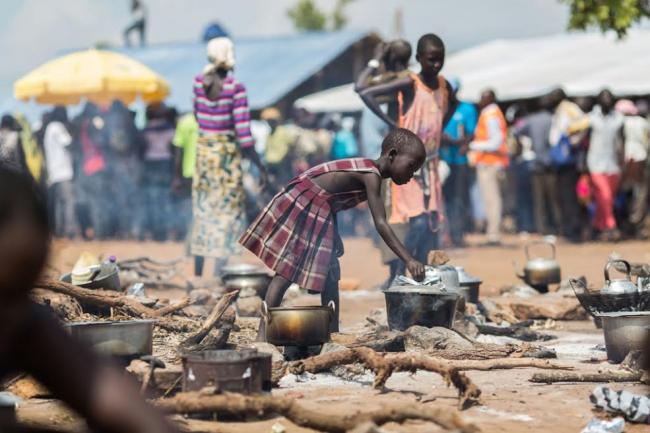
UN and Ugandan government cut food rations amid influx of South Sudanese refugees
“Around 200,000 refugees who arrived in Uganda prior to July 2015 will have their food rations or cash assistance reduced by 50 per cent from this week,” according to a joint press release issued by the Office of the UN High Commissioner for Refugees (UNHCR), the World Food Programme (WFP) and Uganda’s Office of the Prime Minister.
“Low levels of funding, together with a large number of new arrivals fleeing to Uganda from South Sudan since 7 July, have left the refugee response with no choice but to re-prioritize their focus on those refugees in greatest need,” said the release, noting the situation in the region since clashes between rival forces – the Sudan People's Liberation Army (SPLA) and the SPLA in Opposition – broke out in and around the capital, Juba, close to the fifth anniversary of the country's independence.
According to the joint press release, refugees, who arrived after July 2015, along with the especially vulnerable, such as orphans, the elderly, chronically ill and malnourished, would continue to receive a full ration – 2,122 calories of food per day, in line with the minimum recommended daily allowance, during their first year. This would decrease as they became progressively more self-reliant during their time in Uganda. Other refugees received cash assistance in place of food rations, providing them with the opportunity to exercise greater personal choice.
WFP requires approximately $7 million every month to provide life-saving food assistance to refugees in Uganda. Despite the generous support of donors, the humanitarian response needs an additional $20 million to restore full food rations for the rest of the year.
“We have done everything we can to avoid this, but we have been left with no option but to reduce food assistance for many of the refugees in Uganda, in order to stretch available resources and prioritize the most vulnerable new arrivals,” said Mike Sackett, WFP’s acting Country Director for Uganda. “We hope that this is temporary, and we are working as hard as we can to raise the resources needed to restore the full level of food assistance for as many refugees as possible,” he added.
The statement pointed out that the humanitarian response to South Sudanese refugees in Uganda was severely underfunded, even before the July outbreak of violence in Juba – which has since prompted more than 70,000 people to cross the border in to Uganda.
“Never has the international community been more generous in its donations towards refugees,” said the acting UNHCR Representative to Uganda, Bornwell Kantande. “At the same time, never has the gap between what is being provided and what is needed been larger. We thank the donors for their continued generosity and support, while urging them to further fund humanitarian organizations in order that we may continue providing refugees in Uganda with the life-saving assistance they critically need,” he said.
According to the joint statement, new arrivals had spoken of armed groups operating across various parts of South Sudan, attacking villages, burning down houses, murdering civilians, sexually assaulting women and girls and forcibly recruiting young men and boys in to their ranks.
“We are grateful to donors for their unwavering support so far but we appeal to the international community to do more,” said Ugandan Commissioner for Refugees David Apollo Kazungu. “People are fleeing because they are afraid for their lives. Our communities are welcoming them and giving them what we can: land and hope for a better future. But our message to the international community is this: we need your help to meet their basic needs until they are able to stand on their own two feet.”
The Office of the Prime Minister and UNHCR lead and co-coordinate the response to the roughly 600,000 refugees and asylum seekers in Uganda, and collaborate together with WFP to provide new arrivals with life-saving food assistance. By the end of 2015, Uganda was the third-largest refugee hosting country in Africa and the eighth-largest refugee hosting country in the world.
Photo: UNHCR/Will Swanson
Source: www.justearthnews.com
Support Our Journalism
We cannot do without you.. your contribution supports unbiased journalism
IBNS is not driven by any ism- not wokeism, not racism, not skewed secularism, not hyper right-wing or left liberal ideals, nor by any hardline religious beliefs or hyper nationalism. We want to serve you good old objective news, as they are. We do not judge or preach. We let people decide for themselves. We only try to present factual and well-sourced news.
Support objective journalism for a small contribution.


