


Tens of thousands of besieged Syrians receive food aid for first time, UN reports
The UN World Food Programme (WFP) said it has made “significant progress” over the previous few weeks, reaching 3.7 million people in July.
More than 300,000 of those people are in hard-to-reach areas, said spokesperson Elisabeth Byrs, a figure that is “twice the number of people reached using cross-line convoys in June.”
In Moadamiyeh, rural Damascus, the UN agency was for the first time in two years able to bring food rations containing rice, lentils, oil, pasta, bulgur, canned foods, flour, beans, salt and sugar. Access to families there had been blocked since October 2012.
“WFP staff delivering the food reported dire conditions of people severely affected by prolonged hunger,” Byrs said.
The UN agency and partners also reached 10,000 civilians trapped in rural areas of Dar’a, who had not been assisted since the beginning of the crisis over three years ago. On 2 August, Syrian Arab Red Crescent teams distributed aid in opposition-held villages of al-Yadoudah, Tal Shihab and Zaizoun.
Before 14 July, aid deliveries to Syria were not authorized across borders and conflict lines. By the terms of a unanimously adopted resolution, the Council authorized humanitarian agencies and their partners to use the most direct lines to deliver aid, including through four additional border crossings – Bab al-Salam, Bab al-Hawa, al Yarubiyah and al-Ramtha.
For the first time, WFP was able to move food trucks across the Bab al-Salam border crossing from Turkey to Syria on 24 July, providing aid to people cut off in areas of Rural Idleb. More convoys are planned for the coming days, Byrs said.
However, fighting along access routes blocked all deliveries to Ar-Raqqa governorate, in north-central Syria.
“Security challenges continued to hinder WFP’s ability to deliver food, and the organisation remained over half a million short of its goal of reaching 4.25 million people,” the spokesperson noted.
Resources are also dwindling. WFP said it needs to raise $35 million dollars every week in order to meet the food needs of families affected by the conflict in Syria and refugees currently residing in neighbouring countries.
Meanwhile, in al-Hassakeh governorate, in the far north-east corner of Syria, newly displaced families continue to arrive. An ongoing airlift of 23 WFP-chartered flights is flying food rations from Damascus to Qamishli airport in the governorate.
That was bringing critically needed food for 50,000 of the most vulnerable displaced people in contested and opposition-held areas of the governorate including Tal Hamis, Al-Shadaddeh, Markada, Ras Al Ain and Arisha.
Meanwhile, in Homs and Lattakia, WFP has started to provide food vouchers to pregnant women and nursing mothers, allowing them to purchase fresh food, including eggs, dairy, fruits and vegetables.
At least 10.8 million people inside Syria are in urgent need of assistance, according to the UN Office for the Coordination of Humanitarian Affairs (OCHA).
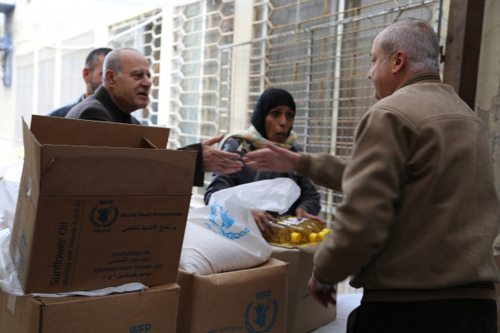
Syrians receiving WFP rations. Photo: WFP/Dina Elkassaby
Support Our Journalism
We cannot do without you.. your contribution supports unbiased journalism
IBNS is not driven by any ism- not wokeism, not racism, not skewed secularism, not hyper right-wing or left liberal ideals, nor by any hardline religious beliefs or hyper nationalism. We want to serve you good old objective news, as they are. We do not judge or preach. We let people decide for themselves. We only try to present factual and well-sourced news.
Support objective journalism for a small contribution.


