


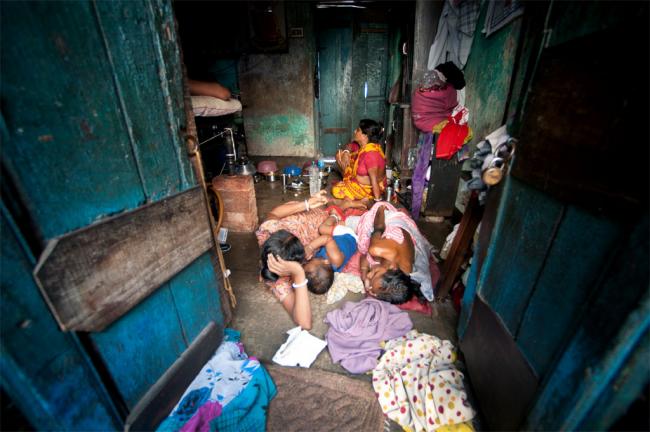
Task of eradicating poverty must be met 'with a sense of urgency,' says deputy UN chief
“Addressing poverty, inequality, climate change, food insecurity and a sluggish and unpredictable global economy requires integrated responses and engagement by all actors,” Mohammed said at the opening of the 2017 Integration Segment of the UN Economic and Social Council (ECOSOC).
“It is [also] an indispensable requirement for sustainable development,” she stressed.
In her remarks, the Deputy Secretary-General highlighted the importance of broad partnerships and building synergies across all dimensions of poverty eradication and sustainable development, including with the different sectors of economy at national levels to address the complex interlinkages.
Further, recalling that the first Sustainable Development Goal (SDG1) is to end poverty in all its forms, everywhere, she added that such efforts also provided an opportunity to gauge how national approaches and the recently adopted SDG Indicator Framework can support each other in advancing integrated implementation and reviewing progress.
“We need options that will enable policy-makers at the global, regional and national level to foster coherent and integrated approaches to poverty eradication,” said Mohammed, noting: “Expectations are very high and now is the time. We have a collective responsibility to deliver results at the country level.”
Also speaking at the opening, Nabeel Munir, the Vice-President of the Economic and Social Council, underscored the importance of integrated policy frameworks given the interconnected nature of sustainable development (the economic, social and environmental dimensions).
“The interlinkages between the different Sustainable Development Goals (SDGs) we have defined to achieve our common vision are explicit, unveiling potential synergies and trade-offs. This underlines the importance of integrated policy frameworks for the realization of the 2030 Agenda for Sustainable Development,” he said, adding:
“It also underlines the significance of this Integration Segment and the discussions that will take place in the context of the 2017 session of the Economic and Social Council's work.”
The 2017 Integration Segment of the Economic and Social Council brings together key stakeholders to discuss and identify opportunities and challenges in developing integrated approaches to tackle poverty in a sustained, inclusive and sustainable manner.
Among other matters it will discuss, the Integration Segment will include a particular focus on Least Developed Countries.
This year's meeting will also consider best practices, lessons learned and recommendations at the national, regional and international levels, with a view to extract policy recommendations to guide integrated policymaking for poverty eradication as an integral part of the 2030 Agenda.
Discussions and outcomes from the Integration Segment will feed into the High-level Segment of the Economic and Social Council as well as into the High-level Political Forum on Sustainable Development.
UN Photo/Kibae Park
Source: www.justearthnews.com
Support Our Journalism
We cannot do without you.. your contribution supports unbiased journalism
IBNS is not driven by any ism- not wokeism, not racism, not skewed secularism, not hyper right-wing or left liberal ideals, nor by any hardline religious beliefs or hyper nationalism. We want to serve you good old objective news, as they are. We do not judge or preach. We let people decide for themselves. We only try to present factual and well-sourced news.
Support objective journalism for a small contribution.


