


 Bangladesh
Tarique Rahman-led BNP's Bangladesh victory: A strategic crossroads for India
Bangladesh’s first general election since the violent July 2024 uprising has delivered a dramatic political comeback for Tarique Rahman and his Bangladesh Nationalist Party (BNP).
The vote not only marks the end of Sheikh Hasina’s long rule but also ushers in a new chapter for India-Bangladesh relations.
Rahman’s rise is layered with political symbolism.
The son of former President Ziaur Rahman and former Prime Minister Khaleda Zia, he returned from years in exile following corruption allegations to claim what his supporters call a historic mandate.
For India, however, the bigger question is not the drama of his return — but what comes next.
India moves first: A calculated welcome
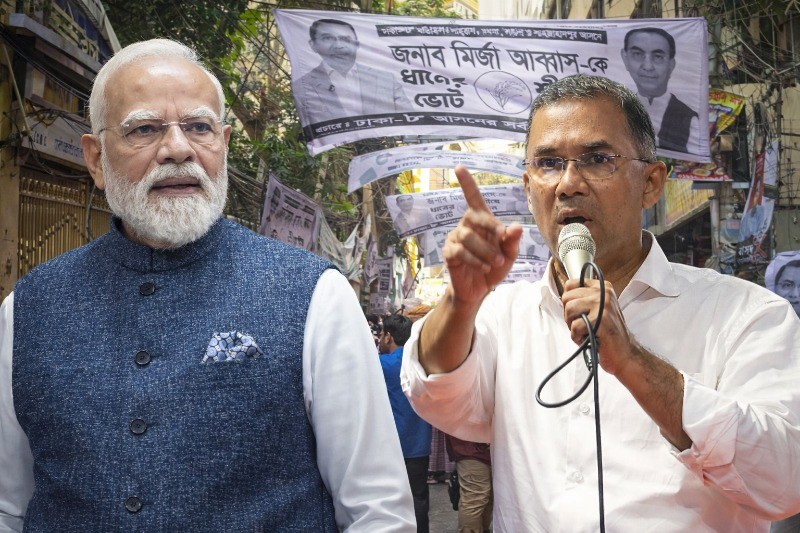
New Delhi was quick to respond. Prime Minister Narendra Modi congratulated Rahman and the BNP, signalling India’s readiness to work with the new leadership.
The prompt outreach was widely seen as a strategic move, aimed at preventing rivals such as China or Pakistan from shaping early diplomatic momentum in Dhaka.
I convey my warm congratulations to Mr. Tarique Rahman on leading BNP to a decisive victory in the Parliamentary elections in Bangladesh.
— Narendra Modi (@narendramodi) February 13, 2026
This victory shows the trust of the people of Bangladesh in your leadership.
India will continue to stand in support of a democratic,…
While the message was diplomatically routine, the underlying signal was clear: India wants stability, predictability and reassurance after nearly 18 months of political upheaval in Bangladesh.
Under Sheikh Hasina and the Awami League, bilateral ties were considered steady and largely pro-India.
The transition to a BNP-led government introduces uncertainty, even if Rahman has publicly pledged to respect India’s interests.
The geopolitical balancing act
India’s core concern lies in the broader strategic map of South Asia.
Analysts have long warned of the possibility of a Pakistan-China-Bangladesh alignment if Dhaka were to tilt away from New Delhi.
The BNP historically adopted a more nationalist “Bangladesh-first” approach under Khaleda Zia.
Rahman has indicated a more pragmatic stance, but India will be watching closely for signs of closer defence or infrastructure engagement with Islamabad and Beijing.
China already has a visible presence in Bangladesh’s infrastructure landscape, including the modernisation of Mongla Port.
For India, such projects are not merely commercial; they carry potential dual-use strategic implications in the Indian Ocean Region.
Recent unconfirmed reports of possible defence cooperation between Dhaka and Pakistan, including talks around JF-17 fighter jets, have only intensified scrutiny in New Delhi.
Border security and domestic political fallout
The 4,100-km India-Bangladesh border remains one of the most sensitive in the region.
Issues such as illegal migration, smuggling and cross-border violence carry direct domestic political implications for India — particularly in West Bengal and Assam, both of which face state elections this year.
Since the fall of Sheikh Hasina in July 2024, Indian data has indicated a spike in infiltration attempts.
Whether Rahman’s government enforces stringent border controls, as Dhaka was perceived to do under Hasina, will significantly influence India’s internal political discourse.
Border stability is not just a bilateral issue; it feeds directly into India’s national security and electoral calculations.
The Hindu minority question
The safety of Bangladesh’s Hindu minority — roughly eight percent of the population — has emerged as another sensitive point.
After Hasina’s removal, reports surfaced of widespread attacks on homes, temples and businesses belonging to Hindus.
India has publicly stated that at least 23 Hindus have been killed since Hasina fled, and New Delhi has demanded visible protections and accountability.
While Bangladesh’s interim administration, led by Muhammad Yunus, acknowledged deaths, it described many incidents as unrelated to communal motives.
Tarique Rahman has promised to ensure minority protection.
However, the BNP’s historical alliances with conservative political elements mean that New Delhi will remain cautious and observant.
Trade: High stakes, high dependence
Economic interdependence forms a crucial pillar of India-Bangladesh ties.
Bilateral trade stands at approximately $14 billion annually, with India enjoying a nearly $10 billion surplus.
Bangladesh’s ready-made garments industry, a backbone of its economy, depends heavily on Indian cotton yarn — which accounts for more than 80 percent of its imports in that sector.
Any deliberate diversification away from Indian suppliers could impact Indian cotton exporters.
However, economic logic suggests continuity. Bangladesh’s post-election recovery will likely prioritise stable supply chains and predictable trade flows.
A sudden pivot could disrupt its own economic rebuilding efforts.
Jamaat factor removed — A relief for New Delhi
One immediate relief for India is the absence of the hardline Bangladesh Jamaat-e-Islami from a governing coalition.
Analysts believe if Jamaat had entered power, it could have significantly complicated India’s security calculus, potentially opening avenues for closer ties with Pakistan and altering the regional balance.
With the BNP projected to hold a clear majority, India anticipates a more transactional — but manageable — relationship.
The bottom line: Wait, watch, engage
India’s approach to Tarique Rahman’s victory will likely combine early engagement with cautious monitoring.
The key variables are capability and intent — whether the new government cooperates on border management, maintains minority protections and avoids destabilising alignments in the region.
Rahman’s return signals a political reset in Dhaka.
For India, it represents neither immediate crisis nor guaranteed continuity, but rather a strategic test of how adaptable bilateral ties can be in a rapidly shifting South Asian landscape.
Support Our Journalism
We cannot do without you.. your contribution supports unbiased journalism
IBNS is not driven by any ism- not wokeism, not racism, not skewed secularism, not hyper right-wing or left liberal ideals, nor by any hardline religious beliefs or hyper nationalism. We want to serve you good old objective news, as they are. We do not judge or preach. We let people decide for themselves. We only try to present factual and well-sourced news.
Support objective journalism for a small contribution.


