


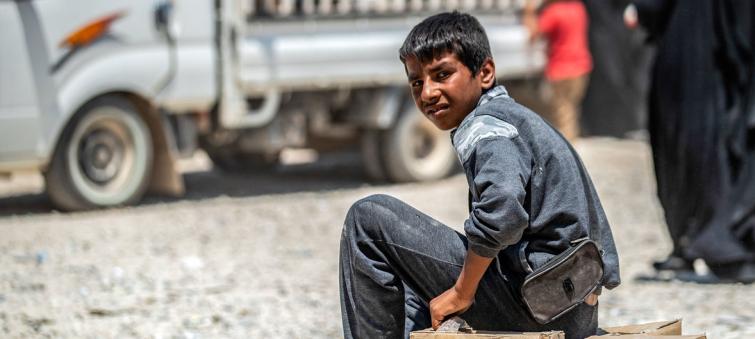
Syrians ‘face unprecedented hunger amid impending COVID crisis’
New York/IBNS: Syrian communities devastated by years of civil war now face an “unprecedented” hunger crisis, just as urgent action is needed to prevent COVID-19 from spreading, UN humanitarians said on Friday.
The warning from multiple UN agencies comes ahead of a major donor pledging conference next Tuesday for the war-shattered country.
To date, nine people have died from the new coronavirus in Syria.
Rural Damascus affected
Most of the relatively low number of confirmed infections have been identified in rural Damascus, in areas under Government control.
But there are serious concerns that Syrians – nine in 10 of whom live on $2 or less a day – are dangerously exposed to the disease should it reach them.
“We’ve only had 248 cases (of new coronavirus infection) in country thus far, but we can take no comfort in that”, said Dr Richard Brennan, Regional Emergency Director for the World Health Organization (WHO)'s Eastern Mediterranean Regional Office.
“We have other countries in the region, the number of cases has got off to a slow start, and we’ve seen in more recent times a real acceleration, so we’ve seen this in Iraq, we’ve seen it in Turkey, we’ve seen it in Egypt and we can fully expect that we will have a similar development in Syria as well.”
The development coincides with an urgent World Food Programme (WFP) appeal for funding to sustain its massive nutrition programme.
200 per cent food price hike
“Syria today is facing an unprecedented hunger crisis as the prices of basic foods reach levels unseen even at the height of the nine-year conflict,” said spokesperson Elisabeth Byrs, noting a 200 per cent food price hike in under a year.
“We’ll continue our work, we’re on the ground…we’re helping 4.8 million people who need food assistance from WFP in Syria’s 14 governorates. We’re going to carry on, but to do that we need $200 million urgently.”
With more than half of Syria’s pre-war population - over 13 million people – now displaced across the country or refugees, UN humanitarian coordinating body OCHA, echoed the need for international support at next Tuesday’s funding summit in Brussels.
“A generation of children has known nothing but hardship, destruction and deprivation,” said Jens Laerke, spokesperson for the Office for the Coordination of Humanitarian Affairs. “Now over 11 million people still inside Syria need aid and protection. The economy across the region is imploding, in Syria it is imploding, not least due to the impact of COVID-19.”
To date, the $3.8 billion Humanitarian Response Plan for Syria is only 30 per cent funded, Mr. Laerke added.
Hospitals out of action
After more than nine years of war, more than half of Syria’s public hospitals and health centres are out of service, according to WHO.
From Damascus to Aleppo, facilities have been reduced to rubble, including a 400-bed national hospital in Homs and a 600-bed complex in Eastern Aleppo, which used to have a nursing school and specialist centres in ophthalmology, paediatrics and nephrology.
Amid such destruction in a country so reliant on international support, the UN is increasingly concerned that COVID-19 would be devastating for all those who live day-to-day, with no social welfare safety net and insufficient personal protective equipment (PPE).
This is despite efforts to boost public health measures to protect vulnerable populations, said WHO’s Dr Akjemal Magtymova, WHO Representative in Syria: “Even in healthcare settings, what I have witnessed crowds of patients in the facilities which are - there is - no use of masks, even among some of the health medical personnel, because of a lack of PPE.”
Insisting that there was still an “opportunity” to stop a widespread COVID-19 outbreak in Syria “that we know is coming”, WHO’s Dr Brennan said that scaling up tried and trusted prevention efforts was essential: “the disease surveillance, the testing, the isolation, the case management, the contact tracing and the community engagement and communications.”
Support Our Journalism
We cannot do without you.. your contribution supports unbiased journalism
IBNS is not driven by any ism- not wokeism, not racism, not skewed secularism, not hyper right-wing or left liberal ideals, nor by any hardline religious beliefs or hyper nationalism. We want to serve you good old objective news, as they are. We do not judge or preach. We let people decide for themselves. We only try to present factual and well-sourced news.
Support objective journalism for a small contribution.


