


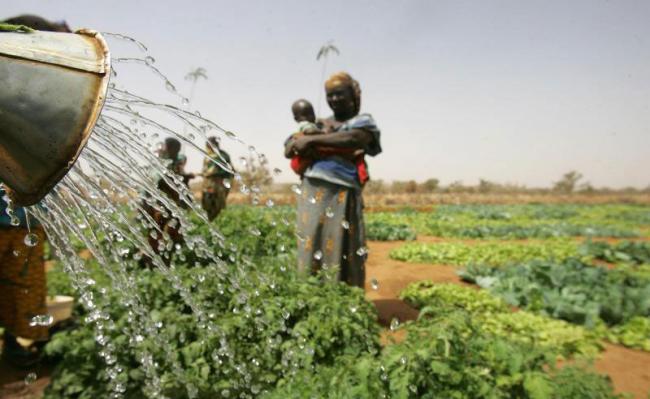
Sustainable agriculture, better-managed water supplies, vital to tackling water-food nexus – UN
“The magnitude of the water-food nexus is underappreciated,” said Pasquale Steduto, UN Food and Agricultural Organization (FAO) Regional Strategic Programme Coordinator for the Near East and North Africa regions.
In his briefing during an event at UN Headquarters in New York, the FAO official also pointed to the fact that a person needs between two to four litres of water for daily consumption, and for domestic uses (washing, etc.) between 40 to 400 litres per family.
But for food and nutritional needs, the requirement is between 2,000 and 5,000 litres per person, depending on diet, or “roughly one litre per kilo-calorie” he explained.
He further emphasized that the nexus is particularly significant for strengthening food security given that the world population is estimated to cross the nine billion mark by 2050, another 50-60 per cent food would need to be produced over current levels to feed everyone.
“This would imply having at least 50 per cent more water – which we will not have. Estimates show we can mobilize up to 10 per cent more, [highlighting] the issue of water scarcity,” added Steduto.
He also stressed the significance of water for the attainment of the Sustainable Development Goals (SDGs).
While Sustainable Development Goal 6 (SDG 6) explicitly calls for ensuring availability and sustainable management of water and sanitation for all, water is a key component for other Goals including those on poverty (SDG 1), hunger and malnutrition (SDG 2), and climate change (SDG 13).
Thus, highlighting the need for intensification of sustainable agriculture, Steduto called for improving efficiency in the use of resources; protecting and conserving natural resources; having a people-centred approach and protecting rural livelihoods; strengthening resilience of people, community and ecosystems, particularly to climate change; and ensuring good governance to safeguard sustainability for natural and human systems.
Speaking further on the response to tackling water scarcity, the FAO official emphasized the need to augment the availability of water, such as through employing large-scale water harvesting methods (including for agricultural purposes), as well as the use of non-conventional water (such as treated waste water and desalination plants).
He also underlined the need to be prudential on the demand side, such as reducing food losses and food waste, and promoting sustainable diets, could also go a long way in staving off water scarcity.
Between supply and demand, he outlined enhancing efficiency and productivity, strengthening governance, employing water saving and optimization technologies, as well as strategic planning and policy for water and food security, including the water-food-energy nexus approach, are important components of addressing this complex challenge.
In his briefing, he also noted FAO initiatives tackling water scarcity at various levels.
Photo: FAO/Giulio Napolitano
Source: www.justearthnews.com
Support Our Journalism
We cannot do without you.. your contribution supports unbiased journalism
IBNS is not driven by any ism- not wokeism, not racism, not skewed secularism, not hyper right-wing or left liberal ideals, nor by any hardline religious beliefs or hyper nationalism. We want to serve you good old objective news, as they are. We do not judge or preach. We let people decide for themselves. We only try to present factual and well-sourced news.
Support objective journalism for a small contribution.


