


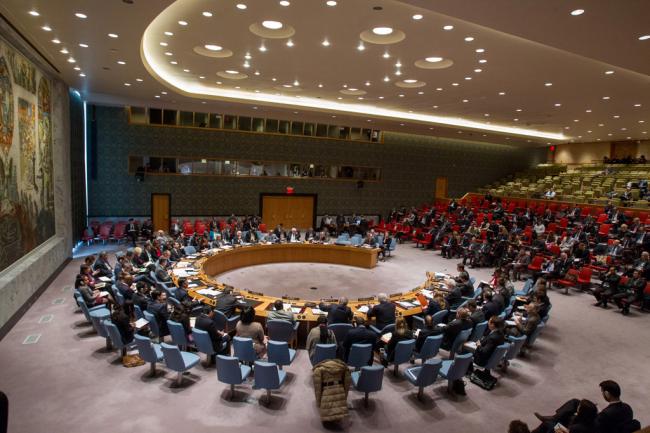
Road ahead will be difficult in Ukraine: UN political chief
“The road ahead will be difficult but it is critical that all concerned strictly adhere to and commence good-faith implementation of this agreement,” said Jeffrey Feltman, Under-Secretary-General for Political Affairs.
Feltman, who was joined in the Council by Assistant Secretary-General for Human Rights Ivan Šimonović, who briefed on the rights situation in the country, and John Ging, the Operations Director for the UN Office for the Coordination of Humanitarian Affairs (OCHA), who briefed on the humanitarian crisis, said a number of significant developments had occurred since his last briefing.
He pointed to the signing on 12 February by the Trilateral Contact Group and rebel representatives of the “Package of Measures for the Implementation of the Minsk Agreements” and the adoption by the Council on 17 February of resolution 2202, which he said provided a “binding international framework” for efforts to reach a lasting solution.
He noted, however, that despite the agreements, fighting continued in Debaltseve, with innocent civilians caught in the cross-fire.
“The rebels’ unabated attacks for control over this strategic area were in clear violation of the agreement they had signed only five days prior,” said Feltman, who went on to note that the situation had since calmed, though the ceasefire remained fragile and was not firmly in place throughout the region.
“Sporadic violations are reported frequently, including south, near Mariupol, and once again near Donetsk airport,” he added.
The Under-Secretary-General also pointed to monitoring of troop withdrawals conducted by the Organization for Security and Cooperation in Europe (OSCE) Monitoring Mission but noted that lack of access and freedom of movement of its monitors left the Mission unable to verify the true extent of the process.
Adding that Ukraine’s President, Petro Poroshenko, had said he would request a UN-mandated peacekeeping force for eastern Ukraine, he said discussions had been held but that the decision was one for Council members.
“The Secretariat would be guided by its decision. To date, no formal request has been received from Ukraine," he said.
Briefing on human rights in eastern Ukraine, Assistant Secretary-General for Human Rights Ivan Šimonović said the situation “remained alarming” and “grave” despite the ceasefire.
A “stark escalation” of hostilities in January and the first half of February led to “increased violations of international human rights law and international humanitarian law, with a sharp spike in casualties and devastating consequences for the local population.”
He noted that full reports on casualties, especially near Donestsk airport and in the Debaltseve area, were still pending but said the Office of the UN High Commissioner for Human Rights (OHCHR) estimated the total number of people killed was now passed the 6,000 mark.
He drew attention to several “disturbing trends,” including the increased use of sophisticated and heavy weaponry and continued indiscriminate shelling of civilian areas by both sides.
Such attacks were taking an escalating toll on civilians, he said, adding that deliberate targeting of civilians may constitute a war crime, and could amount to a crime against humanity if widespread or systematic.
“Hospitals, schools and kindergartens have been shelled, in both Government and armed groups controlled areas, limiting access to healthcare and education,” he said.
He added, “The situation is aggravated by the alleged continued inflow of heavy weaponry and foreign fighters from the Russian Federation.”
Other trends included the fact that civilians have remained trapped in the conflict zone, with ongoing and severe restrictions on freedom of movement, and a clear deepening of the “divide in Ukrainian society,” which was illustrated most clearly by the terrorist attack in Kharkiv that killed four people, and 14 attacks in Odessa since December that targeted pro-Maidan offices and supporters.
“Against this backdrop, it remains absolutely crucial that the Government shows resolve and commitment to fight corruption and to render impartial justice and accountability for all human rights violations, regardless of the perpetrators or the victims,” said Šimonović.
“Impartial accountability can help deter future human rights violations, preserve the confidence of the people in their Government, and contribute towards the healing of psychological wounds.”
That point was taken up by John Ging, OCHA Operations Director. He said five million people across the country are now in need of humanitarian assistance, two million in Government-controlled areas and three million in non-Government-controlled areas.
“One year ago Ukraine had no displaced people,” said Ging.
He said, “Now, as a result of the conflict, there are almost 1.1 million people registered as internally displaced, more than 100,000 of them in the last month. And more than 670,000 people have fled to neighbouring countries.”
With the pause in fighting, people who were previously trapped had fled, adding to the total numbers. While the ceasefire remained fragile, it allowed some humanitarian access to get through.
“Most recently, 62 tons of humanitarian aid was delivered to Donetsk city by UN convoy on 19 February,” he said.
He added, “Supplies included essential hygiene items, warm clothes, blankets, condensed milk powder, drinking water, and medicines.”
He stressed the importance of allowing aid and aid workers safe and unimpeded passage and access to those in need of life-saving assistance and he underlined the fact that needs still far outweighed the combined capacity of the humanitarian community and Government of Ukraine to respond.
“Additional funding to address the immediate humanitarian needs of those affected by this conflict is urgently needed,” he said.
He added, “Ukraine’s Humanitarian Response Plan, launched on 24 February, calls for $316 million to reach 3.2 million people in the most dire humanitarian need. To date, only 13 per cent of this appeal – $42.2 million – has so far been either received or pledged.”
Photo: UN Photo/Loey Felipe
Support Our Journalism
We cannot do without you.. your contribution supports unbiased journalism
IBNS is not driven by any ism- not wokeism, not racism, not skewed secularism, not hyper right-wing or left liberal ideals, nor by any hardline religious beliefs or hyper nationalism. We want to serve you good old objective news, as they are. We do not judge or preach. We let people decide for themselves. We only try to present factual and well-sourced news.
Support objective journalism for a small contribution.


