


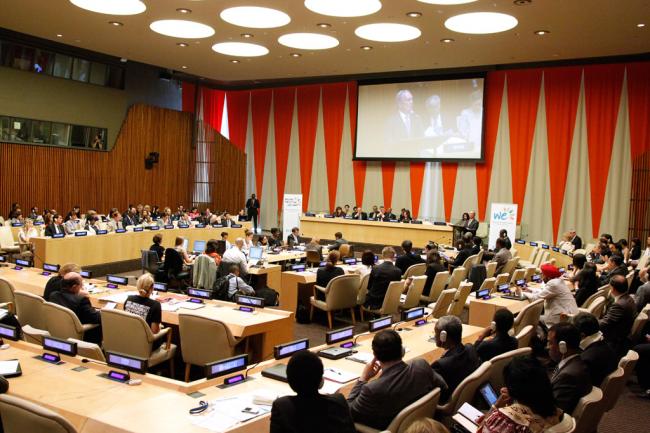
Renewed global development partnership vital to post-2015 agenda: Ban
“Too much is at stake,” Ban Ki-moon said, stressing the need to identify and tackle the root causes of the biggest challenges to economic growth, including heightened geopolitical tension, high youth unemployment and the employment gender gap.
“Strong engagement from all sectors here today illustrates the unprecedented cooperation that is critical to forging ahead on a sustainable development agenda,” Ban said in his opening remarks.
The annual high-level meeting – organized by the UN Economic and Social Council (ECOSOC) included representatives from the World Bank, the International Monetary Fund (IMF), the World Trade Organization (WTO), and the UN Conference on Trade and Development (UNCTAD).
Monday's keynote address was delivered by Deputy Prime Minister of Turkey, Ali Babacan. Several finance ministers, business leaders and civil society representatives are also present for today's and tomorrow's discussion.
“The post-2015 development agenda is ambitious. The financing needs are enormous. They can be met if we work together but we will not succeed unless we forge a partnership and learn the lessons of the current global economy,” the UN chief said today.
“The global economy recovery continues to be sluggish,” Ban continued. “We must ensure the availability of the required resources at all levels, national international public and private.”
Monday's morning session focused on coherence, coordination and cooperation in the context of financing for sustainable development for the post-2015 development agenda. The afternoon thematic debate will address current challenges and emerging opportunities for the mobilization of financial resources.
This meeting comes ahead of July's Third International Conference on Financing for Development (FfD) in Addis Ababa, Ethiopia. The conference will include Heads of State and ministers and will aim to result both in a negotiated and agreed outcome and in summaries of the plenary meetings and other deliberations of the Conference.
Ban said that the Addis Ababa gathering will be an opportunity to devise a politically inclusive development agenda. The outcome must provide three things: first, cohesive and holistic framework for sustainable development; second, concrete deliverables in critical areas and finally, a strong follow-up process to ensure that “no country is left behind,” Ban continued.
“Only a concerted effort by all stakeholders will allow us to succeed. We must work closely together to make this year a year of global action,” he stressed.
Delivering today's opening remarks alongside Ban was President of the Economic and Social Council, Martin Sajdik, who said the meeting comes at a crucial time in history.
“We all have been working closely together this year in order to chart a new era of sustainable development. We have to do our utmost to extend the unprecedented agenda. And it must be with the effort of national, regional and international development,” Sajdik said.
Sajdik said that negotiations of the financing framework have made the international community aware of the wide-range of issues it needs to tackle. Better coordination between public and private investment will maximize its developmental impact.
Past regional and global financial crises have shown that decades of progress can be undone very quickly, he warned. “Indeed, a strong fertile economy would be great ground for the post-2015 agenda,” but crises in Ukraine, Syria, Iraq and Yemen have caused humanitarian challenges of unprecedented proportions and devastated national economies.
“The appalling magnitude of unsolved economic and political challenges must not be ignored,” Sajdik urged. “In order to mitigate these challenges we must strengthen economic cooperation, create productive jobs, maintain financial stability.”
The ECOSOC President also underscored the need to stand up against organized crime and human trafficking. “We all know too well that good governance and rule of law are basic requirements to establish and guard these full societies,” he emphasised.
Putting our planet on the right path lies with governments, however, only a joint effort leveraging the strengthen of governments, businesses, and civil society- based on equity, cooperation and accountability- can affect transformative change.
“Now more than ever, we must work as one and deliver for all,” he said.
Photo: UN Photo/Paulo Filgueiras
Support Our Journalism
We cannot do without you.. your contribution supports unbiased journalism
IBNS is not driven by any ism- not wokeism, not racism, not skewed secularism, not hyper right-wing or left liberal ideals, nor by any hardline religious beliefs or hyper nationalism. We want to serve you good old objective news, as they are. We do not judge or preach. We let people decide for themselves. We only try to present factual and well-sourced news.
Support objective journalism for a small contribution.


