


Palm oil pushes global food prices up in April; cereal production outlook improves – UN
The FAO Food Price Index averaged 151.8 points in April, a 0.7 per cent increase from March. That is about 10 per cent below its level of a year ago and more than a third off its 2011 highs.
The gradual increase is far from even across the board. April’s increase was driven by palm oil prices and, in a minor key, cereals, while sugar prices tapered down after a strong increase in March.
The trade-weighted index tracks international market prices for five key commodity groups: major cereals, vegetable oils, dairy, meat and sugar. Its decline over the past year reflects ample food supplies, a slowing global economy and a stronger US dollar.
Vegetable oil prices rose 4.1 per cent, due largely to a grim 2016 production outlook for palm oil coupled with a growing worldwide demand.
Cereal prices rose 1.5 per cent on the month, due primarily to international maize quotations, themselves influenced by a weaker US dollar and spillover from the oilseeds complex. However, rice prices declined marginally, while wheat markets posted limited gains amid expectations of large supplies in the new season for the crop.
Dairy prices dropped 2.2 per cent as stocks of butter and cheese in major exporters continued to grow.
Meat prices rose 0.8 per cent, pushed up by strengthening United States demand for Australian beef.
Sugar prices, meanwhile, dropped 1.7 per cent in April after a dramatic 17 per cent increase the previous month. While concerns about global sugar production remain, Brazil – by far the main exporter – has had its second-highest crop ever and the country's use of sugarcane for ethanol is expected to decline.
Sugar and vegetable oils are the only sub-indexes currently at levels higher than those of April 2015.
Outlook for cereals output improves
FAO raised its forecast for world cereal production in 2016 slightly to nearly 2,526 million tonnes, virtually the same as in 2015 and potentially on course to be the second-largest global harvest ever, according to FAO’s Cereal Supply and Demand Brief, also released on Thursday.
The larger figure results almost entirely from improved prospects for wheat production, as winter weather conditions have been favourable for prospective yields in the European Union, the Russian Federation and Ukraine. At 717 million tonnes, the 2016 wheat output forecast remains 16 million tonnes short of last year’s record.
FAO’s new production forecast for global coarse grains - including barley, maize, millet, oats, rye and sorghum – stands at 1,314 million tonnes, about one per cent below the 2015 output.
FAO left unchanged its worldwide rice production forecast at 495 million tonnes, about one percent higher than the previous year, although the full impact of the El Niño weather phenomenon will not be clear for a few more months.
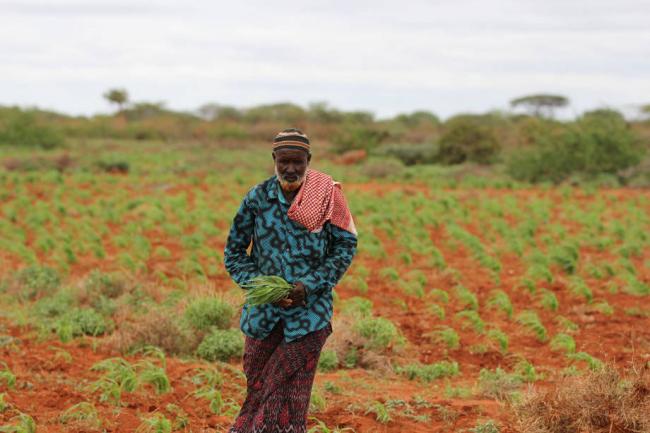
Photo: FAO/Frank Nyakairu
Support Our Journalism
We cannot do without you.. your contribution supports unbiased journalism
IBNS is not driven by any ism- not wokeism, not racism, not skewed secularism, not hyper right-wing or left liberal ideals, nor by any hardline religious beliefs or hyper nationalism. We want to serve you good old objective news, as they are. We do not judge or preach. We let people decide for themselves. We only try to present factual and well-sourced news.
Support objective journalism for a small contribution.


