


On International Day, UNESCO chief says literacy not only improves lives, it saves them
“Literacy facilitates access to knowledge and triggers a process of empowerment and self-esteem that benefits everyone,” Director-General Irina Bokova said in a message for the Day.
This year’s activities for the Day, observed annually on 8 September, are focused on the links between literacy and sustainable development with a literacy award ceremony and a girls’ and women’s literacy conference in Bangladesh. The events underscore the power of literacy to enable people to make choices that promote economic growth, social development and environmental integration.
“Literacy helps reduce poverty and enables people to find jobs and obtain higher salaries. It is one of the most efficient ways of improving the health of mothers and children, understanding doctors’ prescriptions and gaining access to healthcare,” Bokova said.
Between 1990 and 2009, the lives of more than two million children under the age of five were saved thanks to improvements in education of women of reproductive age.
But on Monday more than 781 million adults in the world still cannot read, write or count. Two thirds of them are women in the developing world. But even in high-income countries, education systems are failing significant minorities.
In New Zealand, almost all students from rich households achieve minimum learning standards in grades 4 and 8, but only two-thirds of poor students do. Many immigrants in rich countries are also left behind. In France, for example, fewer than 60 per cent of immigrants have reached the minimum benchmark for reading which may have long-term implications on society.
“What kind of societies do we expect to build with an illiterate youth? This is not the kind of world we wish to live in. We want a world where everyone can participate in the destiny of their societies, gain access to knowledge and enrich it in turn,” Bokova said.
She added that the world must change its traditional approach of literacy programmes to encompass broader skills with regard to consumption and sustainable lifestyles, the conversation of biodiversity, poverty reduction, disaster risk reduction as well as civic participation.
Commitment to these goals will be central to the forthcoming Aichi-Nagoya conference on education for sustainable development to be held in Japan this November. It will also be discussed at the World Education Forum to be held next year in Incheon, Republic of Korea, to lead the global debate towards the adoption of new sustainable development goals at the UN General Assembly in 2015.
UNESCO is working across the world, including in Afghanistan, Bangladesh, Cambodia, Egypt, Nigeria, and Senegal, to ensure that literacy is integrated into national development strategies. However, more must be done.
“We must invest more,” said Bokova, “I appeal to every Member State and all our partners to redouble efforts – political and financial – to ensure that literacy is fully recognized as one of the most powerful accelerators of sustainable development. The future we want starts with the alphabet.”
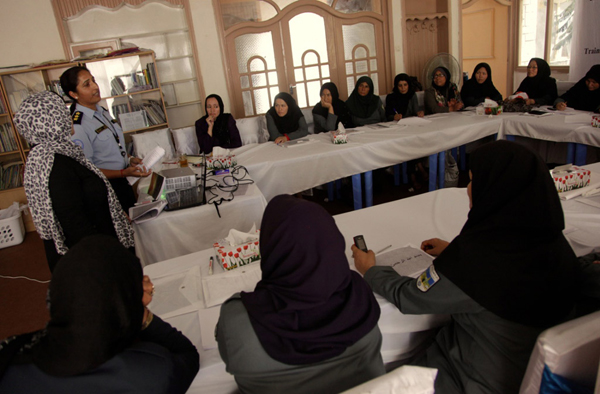
Women police in Herat, Afghanistan, boost their literacy through UNAMA’s Ustad Mobile programme. Photo: UNAMA
Support Our Journalism
We cannot do without you.. your contribution supports unbiased journalism
IBNS is not driven by any ism- not wokeism, not racism, not skewed secularism, not hyper right-wing or left liberal ideals, nor by any hardline religious beliefs or hyper nationalism. We want to serve you good old objective news, as they are. We do not judge or preach. We let people decide for themselves. We only try to present factual and well-sourced news.
Support objective journalism for a small contribution.


