


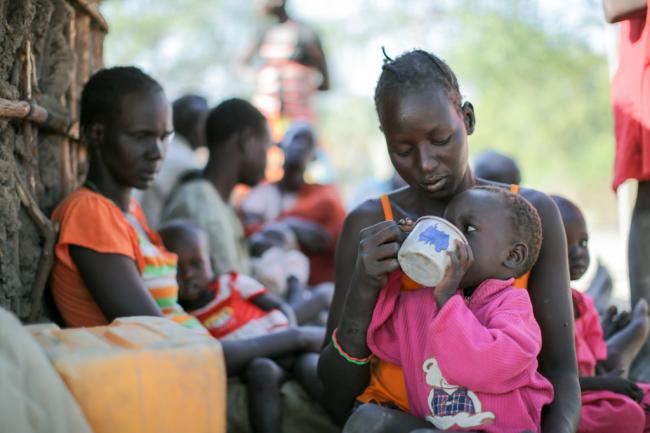
Millions across Africa, Yemen could be at risk of death from starvation – UN agency
“An avoidable humanitarian crisis in the region, possibly worse than that of 2011, is fast becoming an inevitability,” Adrian Edwards, a spokesperson for the Office of the UN High Commissioner for Refugees (UNHCR) told journalists at the regular bi-weekly media briefing in Geneva.
“A repeat must be avoided at all costs.”
According to estimates, some 20 million people are living in areas hit hard by drought. About 4.2 million among them are refugees and the number of the displaced is rising as a result of consecutive harvest failures, famine and insecurity.
Worst affected are children and lactating mothers.
In southeast Ethiopia, for example, acute malnutrition rates among newly arriving Somali refugee children aged between 6 months and five years is reported in the range of 50-79 per cent. Similarly, in South Sudan, children account for the majority of the refugees (about 62 per cent).
An avoidable humanitarian crisis in the region, possibly worse than that of 2011, is fast becoming an inevitability
Nearly all refugees, including these children, are dependent on food assistance, such as those provided by the World Food Programme – the UN's emergency food relief agency – but with lack of funds to buy food rations are being cut. Worst hit are those in Uganda where rations have been cut by up to 75 per cent. Ethiopia, Tanzania, and Rwanda (by between 20 and 50 per cent) and Djibouti (by 12 per cent) are also witnessing this decrease.
“Many refugees are without full access to livelihoods and agriculture or food production and their ability to take matters into their own hands and help themselves is limited,” noted Edwards.
Drastic situation turning worse in countries
The daunting humanitarian scenario has been further complicated by a range of challenges including new displacement, economic hardships, crop failure and conflict.
In Somalia, of the half a million people displaced since November, 278,000 were displaced in the first quarter of this year and the country continues to see a complex situation of both outflows and returns, mainly from Yemen.
Furthermore, in famine hit parts of South Sudan, increase in fighting, insecurity, lack of access to aid and a collapsing economy have left 100,000 people facing starvation and a further one million people are now on the brink of famine.
The humanitarian situation in Yemen, too continues to decline. Already the world's largest humanitarian crisis, food needs are being cited as the lead factor in displacement at three quarters of all locations across the war-torn country where there are internally displaced people.
UN efforts scaled up but resources extremely scarce
Responding to the growing crisis, the UN refugee agency and its partners have been scaling up their efforts.
However, UNHCR operations in these countries are facing considerable constraints due to limited funding.
“It is now urgent that the shortfalls be addressed,” underscored the UNHCR spokesperson.
Almost five million children could be out of school
The severe food insecurity is also causing many students, such as those in Kenya, to drop out of school. Some 175,000 students in drought areas in the country have stopped attending school and almost 600 schools have closed in Ethiopia.
In all, some five million children could see their educations being disrupted over coming weeks and months.
Photo: UNHCR/Rocco Nuri
Source: www.justearthnews.com
Support Our Journalism
We cannot do without you.. your contribution supports unbiased journalism
IBNS is not driven by any ism- not wokeism, not racism, not skewed secularism, not hyper right-wing or left liberal ideals, nor by any hardline religious beliefs or hyper nationalism. We want to serve you good old objective news, as they are. We do not judge or preach. We let people decide for themselves. We only try to present factual and well-sourced news.
Support objective journalism for a small contribution.


