


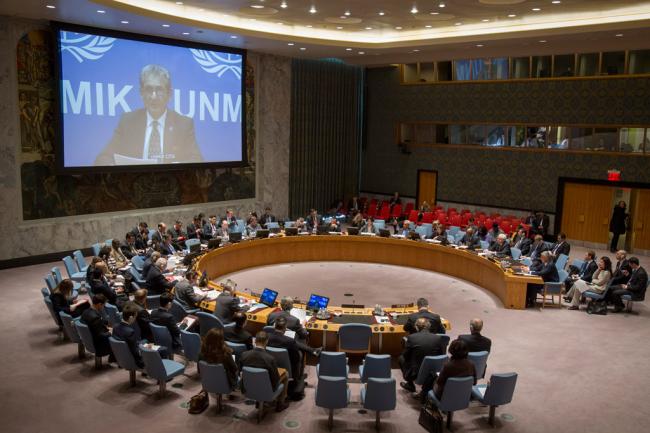
Kosovo: UN envoy calls on parties to engage in dialogue, make 'hard choices' for regional stability
“From its inception, the European Union-facilitated dialogue between Belgrade and Pristina has been about making hard choices between the past and the future, between stagnation and progress and between consolidating political power and doing what is in the best interest of the people in the region,” Farid Zarif told the 15-member Council via video teleconference from Pristina, ahead of a debate on the issue.
Introducing the Secretary-General’s latest report, Zarif, who is also the Head of the United Nations Interim Administration in Kosovo (UNMIK), said that, in December 2015, a new Kosovo government was formed as the result of an alliance between two major political parties.
Over the past weeks, however, the government has responded to mass protests in Pristina on 24 and 27 January that caused scores of injuries and destruction of property, he said. The protests demanded the resignation of a Kosovo Serb minister over remarks attributed to him at previous protests and the reversal of law asserting public ownership of a large mining enterprise. It also seemed to be fuelled by discontent with the economic situation.
Calling peaceful protest a right, but violence deplorable, Zarif commended the proportional reaction of the Kosovo police and the condemnation of the violence by political and civil leaders in Kosovo. Unfortunately, a small number of political figures, mostly from the opposition, attempted to exploit the situation. He called for “measured” discussions of the issues that sparked the protest, so that the new government could make progress on its stated objectives.
On dialogue between Belgrade and Pristina, set to resume on 9 February in Brussels, he highlighted the need for the Kosovo side’s early commitment to the establishment of an “association/community of Serb-majority municipalities,” as well as the importance of delving into new areas.
Praising “sensible choices in priorities” of the new coalition government and the Kosovo Assembly, he urged the swift completion of actions required for justice, reconciliation and economic progress. Applauding also the swift drafting of a law criminalizing participation in armed conflicts outside Kosovo, he urged further consideration of the draft in consultation with concerned representatives of the international community. Noting that dozens of terror suspects had been arrested, he encouraged the continuation of a multidimensional approach to the problem that included engagement of religious and political leaders.
Welcoming steps to address social inequality, high unemployment and the growing illegal emigration to Western Europe, Zarif urged the Pristina authorities to proceed judiciously in those matters and continue availing themselves of the many sources of advice the international community could offer.
Finally, he noted progress in protection of cultural heritage, calling for enhanced local dialogue to resolve remaining challenges, and urged that political will be mustered to bring about swift closure of the 1,655 outstanding cases of missing persons.
UN Photo/Loey Felipe
Support Our Journalism
We cannot do without you.. your contribution supports unbiased journalism
IBNS is not driven by any ism- not wokeism, not racism, not skewed secularism, not hyper right-wing or left liberal ideals, nor by any hardline religious beliefs or hyper nationalism. We want to serve you good old objective news, as they are. We do not judge or preach. We let people decide for themselves. We only try to present factual and well-sourced news.
Support objective journalism for a small contribution.


