


'Indigenous peoples' must feature in new global development agenda, stress UN experts
“Indigenous peoples face distinct development challenges, and fare worse in terms of social and economic development than non-indigenous sectors of the population in nearly all of the countries they live in,” the experts said in a news release.
“However, they can also contribute significantly to achieving the objectives of sustainable development because of their traditional knowledge systems on natural resource management which have sustained some of the world’s more intact, diverse ecosystems up to the present.”
The experts speaking out on this issue are Dalee Sambo Dorough, the current chair of the UN Permanent Forum on Indigenous Issues; Albert Deterville, who heads the five-member Expert Mechanism on the Rights of Indigenous Peoples; and Victoria Tauli-Corpuz, the new UN Special Rapporteur on indigenous peoples.
Member States are working on elaborating a set of sustainable development goals that will follow the targets known as the Millennium Development Goals (MDGs), which world leaders have pledged to achieve by 2015.
The MDGs – covering a range of poverty, hunger, health, gender equality, education and environmental indicators – have been the most successful global anti-poverty push in history. Several targets have already been met, such as halving the number of people living in extreme poverty, and it is expected that more targets will be reached by the end of 2015.
The post-2015 development agenda seeks to address any unfinished business of the MDGs and new challenges and complexities facing the world with sustainable development at its core and poverty eradication as its highest priority.
The experts noted with concern that all references to ‘indigenous peoples’ have been deleted in the latest draft document being discussed by the open-ended Working Group on Sustainable Development Goals, even though the term had been included in earlier drafts.
The Working Group, which met last week in New York, is tasked with drafting the sustainable development goals which will be presented to the General Assembly in September.
“Using the term ‘indigenous and local communities’ undermines the gains achieved by indigenous peoples regarding their assertion of their distinct status and identity as peoples and the rights accorded to them under the United Nations Declaration on the Rights of Indigenous Peoples and other international instruments,” the experts said.
They urged Member States in the open-ended Working Group to listen to the proposals made by indigenous peoples’ representatives and to ensure that the term ‘indigenous peoples’ will be used consistently in the outcome document.
“It has been widely acknowledged that indigenous peoples have not been accorded the attention they deserve in national development processes and efforts to achieve the Millennium Development Goals,” the experts said.
“The new Sustainable Development Goals present a unique opportunity to remedy these shortcomings and the historical injustices resulting from racism, discrimination and inequalities long suffered by indigenous peoples across the world,” they underscored.
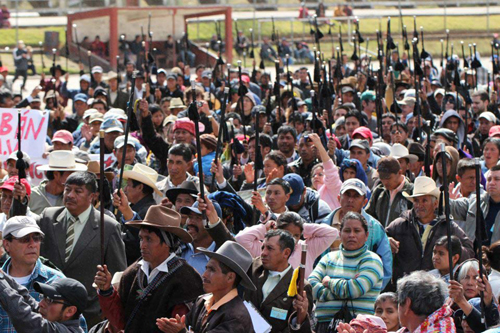
Indigenous people in Totonicapán, Guatemala. Photo: OHCHR/Rolando Alfaro
Support Our Journalism
We cannot do without you.. your contribution supports unbiased journalism
IBNS is not driven by any ism- not wokeism, not racism, not skewed secularism, not hyper right-wing or left liberal ideals, nor by any hardline religious beliefs or hyper nationalism. We want to serve you good old objective news, as they are. We do not judge or preach. We let people decide for themselves. We only try to present factual and well-sourced news.
Support objective journalism for a small contribution.


