


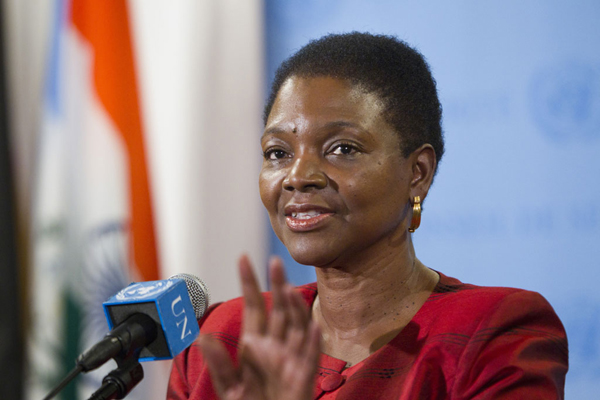
In Iran, UN relief chief urges cooperation to deal with region's 'unprecedented' crises
Speaking to the press in Tehran, Valerie Amos, Under-Secretary-General for Humanitarian Affairs, said Iran had “a very important role to play in helping us gain better access for humanitarian organizations in Syria and elsewhere.”
“I have had an important opportunity to discuss with Government partners ways in which we can strengthen our partnership to improve regional cooperation on humanitarian assistance and also to discuss the major humanitarian crises in the region.”
Amos said she had already met with the President of Iran's National Disaster Management Organization to discuss ways to collaborate on information management, enhancing operational effectiveness, knowledge sharing and capacity building.
She had also met with Iran's Minister of Foreign Affairs, Mohammad Javad Zarif to talk about the humanitarian situations in Syria, Iraq and Gaza.
In Syria, almost 11 million people are in need, up from 1 million just three years ago, Amos said calling it an “unprecedented” crisis. Out of those, 4.7 million people live in areas that are hard to reach while 241,000 live in besieged communities.
In Iraq, people are facing an “unravelling” crisis, which has already caused one of the largest internal population displacements in the world.
“Attacks, systematic persecution and grave human rights abuses against civilians by the so-called Islamic State and other armed groups are outrageous,” she declared.
Meanwhile, in Gaza 1,975 Palestinians, including 1,417 civilians, and 67 Israelis were killed during the conflict. An estimated 10,000 people have been injured, including 3,000 children and 3,000 women. Hospitals, schools and shelters will take months to rebuild.
In all three crises, UN agencies were supporting national, regional and local aid efforts. In Syria, the World Food Programme (WFP) dispatched food for 3.7 million people and World Health Organization (WHO) distributed medicines and supplies for more than half a million people.
Meanwhile, in both Iraq and Gaza, UN response continues, including deliveries of food, water and household goods. Medicines and fuel are being delivered to hospitals.
“But this is not enough,” Amos said, adding that insecurity and the fragmentation of armed groups continues to hamper relief efforts. For example, in Syria medical supplies are constantly denied in humanitarian convoys. She looked forward to working more closely with Iranian partners to improve the humanitarian response and help gain better access.
“My job and that of our humanitarian partners is to be as effective as possible in our aid delivery and ensure that we can reach more people, more quickly,” she added.
Under-Secretary-General for Humanitarian Affairs Valerie Amos. UN Photo/Rick Bajornas
Support Our Journalism
We cannot do without you.. your contribution supports unbiased journalism
IBNS is not driven by any ism- not wokeism, not racism, not skewed secularism, not hyper right-wing or left liberal ideals, nor by any hardline religious beliefs or hyper nationalism. We want to serve you good old objective news, as they are. We do not judge or preach. We let people decide for themselves. We only try to present factual and well-sourced news.
Support objective journalism for a small contribution.


