


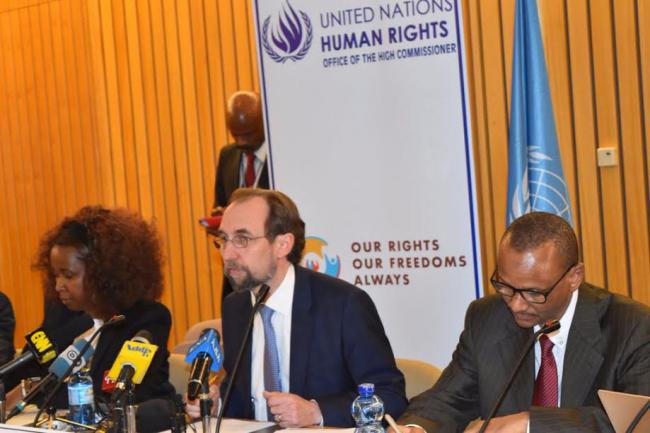
In Ethiopia, UN rights chief urges authorities for greater freedoms; space for critical voices
“All governments need to be held to the mark by independent media and the vital action of civil society and human rights defenders,” High Commissioner Zeid Ra’ad Al Hussein said at a press conference in the capital, Addis Ababa.
“I am convinced the Ethiopian Government will find its most important and productive investment will be in the rights of the people, which build strong and safe societies.”
In his remarks, the UN rights chief hailed the contributions of the Horn of Africa country ranging from its contributions to UN peacekeeping efforts as well as its commitment to protect the human rights of its people as illustrated by its accession to a number of human rights treaties and their reflection in the Ethiopian constitution.
He also expressed that the work of the Ethiopian Human Rights Commission was heartening and called on the Government to continue further steps to grant the body more independence.
However, speaking on the unrest in the country in November 2015 and August 2016, and the response of the security forces, Zeid urged the authorities to allow access to UN human rights officials to visit the affected region and establish the facts.
“The extremely large number of arrests – over 26,000 – suggests it is unlikely rule of law guarantees have been observed in every case. I believe my staff ought to be given access to the affected areas, and I renew my request,” he added, noting that he would continue to follow-up on the case.
The High Commissioner also spoke on the importance of economic, social and cultural rights and stressed that progress on these rights would translate into civil and political rights advances.
He also offered his support and that of his Office, OHCHR, to the Government and the people of Ethiopia in confronting the challenges posed by the drought plaguing large parts of the region.
During his visit, High Commissioner Zeid met with a number of senior Ethiopian officials, including the Prime Minister, Hailemariam Desalegn, Ministers, legislators, and human rights officials and defenders.
Also, while in Ethiopia, the UN top human rights official signed a Memorandum of Intent with the Government to strengthen OHCHR Regional Office in Addis Ababa programmes on capacity building for stakeholders across the region, including Ethiopia.
During his mission, Zeid also met with Chairperson of the African Union Commission, Moussa Faki Mahamat, and other senior African Union (AU) officials, with whom he discussed human rights priorities with the AU, as the regional bloc’s new leadership develops its vision and frameworks for impact across the continent.
Photo: UN/Ahunna Eziakonwa
Support Our Journalism
We cannot do without you.. your contribution supports unbiased journalism
IBNS is not driven by any ism- not wokeism, not racism, not skewed secularism, not hyper right-wing or left liberal ideals, nor by any hardline religious beliefs or hyper nationalism. We want to serve you good old objective news, as they are. We do not judge or preach. We let people decide for themselves. We only try to present factual and well-sourced news.
Support objective journalism for a small contribution.


