


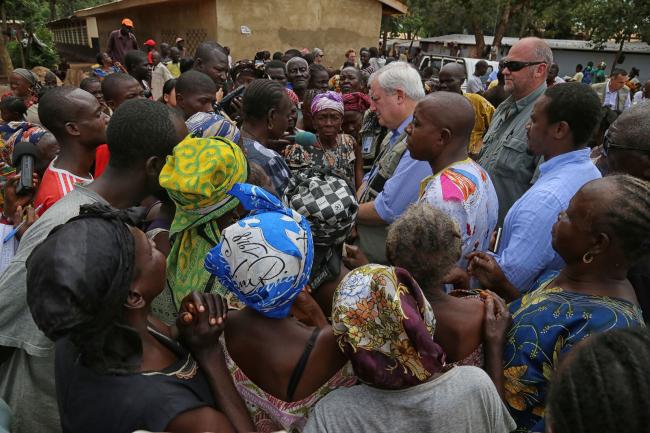
FEATURE: UN aid chief calls on leaders to ‘make commitments for the future’ at World Humanitarian
“The Summit is a way of saying let’s come together, let’s really understand how we can work better, let’s make commitments for the future,” Stephen O’Brien, the Under-Secretary-General for Humanitarian Affairs told the UN News Centre ahead of the first-ever gathering of its kind, which will take place in Turkey on 23 and 24 May.
More than 125 Heads of Government and State are expected to join representatives from the UN community, civil society, the private sector, academia and tens of thousands of other participants in Istanbul.
The Summit is a way of saying let’s come together, let’s really understand how we can work better, let’s make commitments for the future
“With lots of Heads of Government, Heads of State coming, many, many countries represented, that will drive forward our agenda for the next few years,” O’Brien added, highlighting the importance of strong political will in the action that will be agreed to in the Summit.
One of the areas that will be discussed is how to get humanitarian aid faster and more effectively to the people who need it most.
“Whenever there is suffering and humanitarian need in a crisis, all of us want to be there even faster than we ever can be because we’re all driven by this wish to help people in need,” O’Brien said, but cautioned that “practical, secured, safe passage and unimpeded access” is challenging during protracted crises, particularly of ongoing conflict.
There are more than 125 million people in need of immediate humanitarian assistance worldwide, according to UN figures. That includes refugees, displaced persons, and people who are in need of support due to climate-induced famine.
To put that figure in perspective, together, they would create the 11th largest country in the world.
“But they don’t have a flag, they don’t have a Head of State,” said O’Brien.
They do have urgent needs that must be met through goods and services. These are expected to cost the humanitarian community an additional $15 to $20 billion annually.
While the event is not a fund-raising conference, investing in humanity is one of the five core responsibilities that Secretary-General Ban Ki-moon has urged in his report for the World Humanitarian Summit. The four other responsibilities of the Agenda for Humanity are preventing and ending conflict, respecting the rules of war, leaving no one behind, and working differently to end need.
If put into practice, the idea is that the Agenda for Humanity would allow humanitarians to provide for the immediate needs when crises hit while also preparing for the long-term so people can see hope in their futures. In most cases, that means being able to return home and rebuild their lives.
“I was particularly struck by a family that I talked to in Jordan who had had to run away from their home, flee because it had been completely destroyed by bombs outside of Homs, in Syria,” O’Brien recalled. The family, including four children, had been living in Amman, Jordan, for the past three years. The father at the time did not have permission to work.
MINUSCA/Nektarios Markogiannis
Source: www.justearthnews.com
Support Our Journalism
We cannot do without you.. your contribution supports unbiased journalism
IBNS is not driven by any ism- not wokeism, not racism, not skewed secularism, not hyper right-wing or left liberal ideals, nor by any hardline religious beliefs or hyper nationalism. We want to serve you good old objective news, as they are. We do not judge or preach. We let people decide for themselves. We only try to present factual and well-sourced news.
Support objective journalism for a small contribution.


