


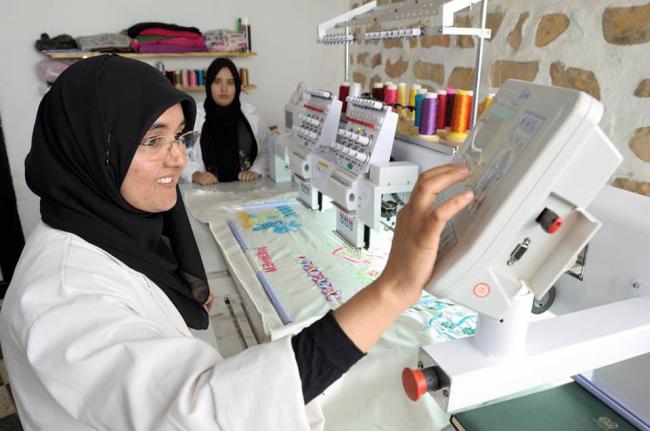
Enabling youth to shape their own future key to Arab region’s development progress – UN report
The report, Arab Human Development Report (AHDR) 2016: Youth and the Prospects for Human Development in a Changing Reality, urges countries to adopt policies that guarantee the well-being, productivity, self-determination, and good citizenship of their young people.
“The wave of uprisings that have swept across the Arab region since 2011 has shown us that we can no longer treat young people in the Arab region as passive dependents or a generation-in-waiting,” said Sophie de Caen, acting Director of the Regional Bureau for Arab States in UNDP.
Young people in Arab countries on Thursday are more educated, mobile, and connected than ever before. As a result, he says, “Arab countries can reap the huge demographic dividend that [their] young populations represent if they invest in enhancing the capacities of their youth and enlarging opportunities available to them.”
“It starts from a younger age,” said Adel Abdel Latif, the report’s Coordinator and Senior Strategic Advisor at UNDP’s Regional Bureau for Arab States. Key to such investments are, he added, “giving them a good education, empowering them and helping them in their studies in school and critical thinking, and also making sure that they’re able to compete at the global level.”
On Thursday, there are some 150 million people aged 15-29 in the region. 60 per cent are under the age of 30. The report thus urges countries to take action to secure their futures by investing in youth.
Gains in health and education led to increases in the Human Development Index (HDI) in all Arab countries between 1980 and 2010, but incomes fell behind. The HDI measures wellbeing through factors that include a long and healthy life, education and knowledge, and a decent standard of living.
However, since the 2008-2009 global economic crisis and political instability that began in 2011, annual growth in the HDI has dropped by more than half from 2010 to 2014. Arab young people are unfortunately facing unfavourable conditions for development.
According to the report, these conditions are creating obstacles and leading to cultural, social, economic, and political exclusion.
While education has improved, these gains have failed to translate into good jobs – unemployment among youth in the region is thus twice the global average, and the report expects the situation to deteriorate further. Weak political engagement is another problem: while youth participate in public protests, voting rates for this demographic in Arab countries are the lowest worldwide.
It also cites pervasive discrimination against women, a result of deep-seated sexism, embedded cultural beliefs and traditions in childrearing, education, religious structures, the media, and family relations, and various legal obstacles, all of which present serious barriers to progress.
As Latif explained in an interview with UN Radio, “Development should be engendered, otherwise it will be endangered. If development does not begin with women as equal partners with men in their societies, it will not be a complete development and it will have a huge impact on society.”
These factors create frustration, marginalization, and alienation from institutions. While the overwhelming majority of young people in Arab regions have no desire to engage in extremist groups or activities, a significant minority is open to participating in violent activities that can lead to radicalization.
The report therefore advocates for new development models in order to accommodate for younger generations. A call for empowering youth is not, the UNDP says, only to support young people, but also to rebuild Arab societies as a whole and create a better future.
Photo: UNDP
Source: www.justearthnews.com
Support Our Journalism
We cannot do without you.. your contribution supports unbiased journalism
IBNS is not driven by any ism- not wokeism, not racism, not skewed secularism, not hyper right-wing or left liberal ideals, nor by any hardline religious beliefs or hyper nationalism. We want to serve you good old objective news, as they are. We do not judge or preach. We let people decide for themselves. We only try to present factual and well-sourced news.
Support objective journalism for a small contribution.


