


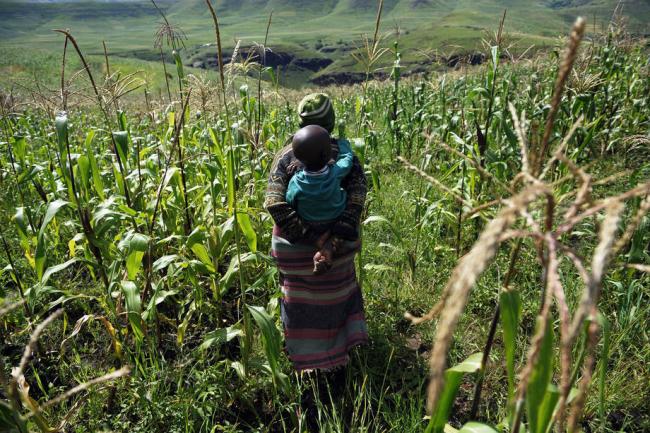
Dip in Southern Africa’s maize harvest could push up prices, UN warns
For 2015, the early production forecast for maize – a staple food throughout the subregion – stands at about 21.1 million tonnes, some 15 per cent lower than the average for the last five years, FAO noted .
The fall is mostly due to the impact of erratic weather conditions, including the late start of seasonal rains in November, followed by heavy rains that caused flooding, and then a long dry spell in the southern areas of the subregion during February and early March.
“Last year, the subregion saw a bumper harvest, which has made this year’s harvest prospects look even weaker so we have to be cautious until governments, often with the support of FAO, have completed all the assessments in the coming days,” said David Phiri, FAO’s Subregional Coordinator for Southern Africa.
“The carry-over stocks from 2014’s bumper maize crop is expected to partly offset the impact of lower domestic production and somewhat contribute to stabilising national supplies in some countries,” he added.
Malawi and Zambia, the second and third biggest maize producers in the subregion, are also expected to register smaller harvests compared with the 2014 bumper crop. Lower maize harvests are also anticipated in Botswana, Lesotho, Madagascar, Mozambique, Namibia, Swaziland and Zimbabwe.
The poor outlook is already having some impact on cereal markets. South Africa recorded significant price increases in February – although the rise eased in March following improved rains.
These price increases are expected to mostly affect those countries that rely more on maize imports such as Namibia where relatively high price increases were recorded in February.
In most countries, maize prices have remained below the same period last year due to the current ample supplies, which are expected to rapidly dwindle.
The poor outlook for 2015 is expected to result in increased imports in Southern Africa with forecasts for aggregate maize imports in the 2015/16 marketing year indicating an increase to about 1.8 million tonnes, approximately double the low level of 2014/15, the FAO said.
In Zimbabwe, large volumes of maize imports are forecast, and larger import volumes than 2014 are also forecast in the deficit-producing countries of Botswana, Lesotho, Namibia and Swaziland. Given the contraction in South African export availabilities, alternative export supplies may be needed.
The expected decline in 2015 maize production follows a favourable year in 2014 when ample supplies and low prices contributed to improved food security conditions that resulted in a significant decline of people in need of food assistance in the subregion, with Zimbabwe, for instance, recording a 75 per cent decrease.
Photo: FAO/Gianluigi Guercia
Support Our Journalism
We cannot do without you.. your contribution supports unbiased journalism
IBNS is not driven by any ism- not wokeism, not racism, not skewed secularism, not hyper right-wing or left liberal ideals, nor by any hardline religious beliefs or hyper nationalism. We want to serve you good old objective news, as they are. We do not judge or preach. We let people decide for themselves. We only try to present factual and well-sourced news.
Support objective journalism for a small contribution.


