


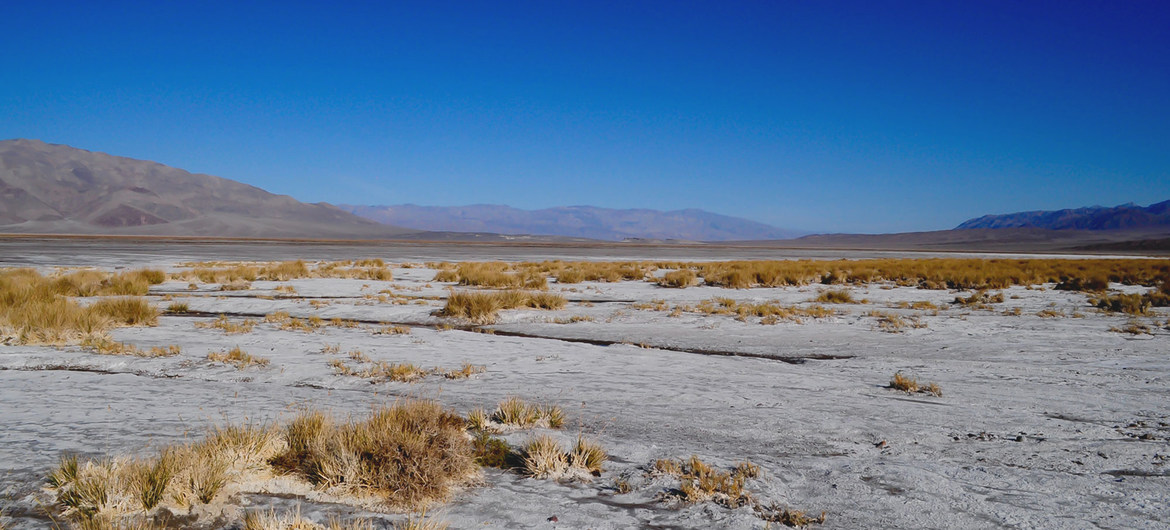
 death Valley
Death Valley temperature, likely highest since 1931: UN weather agency
New York: “All indications” suggest that the extreme temperature reading of 54.4 degrees Celsius recorded in California’s Death Valley on Sunday, is legitimate, the World Meteorological Organization (WMO) said on Tuesday.
“The weather station at Furnace Creek in Death Valley, California, reported a temperature of 54.4C, which is 130F, on Sunday 16 August,” said Clare Nullis, WMO spokesperson. “If validated, it would be the highest temperature on Earth since 1931, and the third-hottest temperature ever recorded on the planet.”
Experts on the case
Speaking in Geneva, Nullis told journalists that WMO had tasked a panel of international experts to verify the reading by examining the observation, the equipment used, how it was calibrated and how it compared to data gathered at surrounding stations.
According to WMO’s Weather and Climate Extremes archive, the hottest temperature ever recorded was in Furnace Creek, Death Valley, California, reaching 56.7C (134.06F) on 10 July 1913. The next highest temperature was set in July 1931 in Kebili, Tunisia, reaching 55C (131F).
Other high temperature records include 54C (129.2F) in Mitribah, Kuwait, on 21 July 2016.
Preliminary findings indicate that the equipment at Furnace Creek meteorological station was in proper working condition at the time of Sunday’s observation, Ms. Nullis noted.
A ‘legitimate observation’
Although the full verification process will likely take many months, she said that the UN agency’s weather and climate extremes rapporteur, Randall Cerveny, had already said “all the indications so far are that this is a legitimate observation”.
The scorching conditions have coincided with a heatwave on the U.S. west coast. The US National Weather Service has issued numerous heat warnings indicating that the intense and extreme temperatures will continue this week.
“The National Weather Service in Las Vegas which covers the Death Valley area tweeted, ‘we are in the midst of a long-duration extreme heat event. Another run at 130F-plus temperatures in Death Valley remains possible,’” Ms. Nullis added.
The development follows repeated warnings from the UN weather agency about extreme high temperatures which are having an impact on sea ice melt, also causing extensive wildfires in places such as the Arctic.
Western and Central Europe witnessed another heatwave last week, Ms. Nullis explained, with a number of new weather station records being set.
Arctic alarm
On 17 August, Japan registered 41.1C (105.98F) at Hamamatsu, tying its national record.
Siberia, meanwhile, has experienced a prolonged heatwave, with a recorded temperature of 38C (100.4F) on 20 June in the Russian town of Verkhoyansk.
WMO is now examining this reading, which if verified, would be the highest temperature ever recorded in the Arctic Circle.
“July was the hottest July on record for the northern hemisphere and the Arctic sea ice was the lowest on record,” Ms. Nullis said. “The January to July period – the seven-month period - was the second-warmest such period on record.”
Support Our Journalism
We cannot do without you.. your contribution supports unbiased journalism
IBNS is not driven by any ism- not wokeism, not racism, not skewed secularism, not hyper right-wing or left liberal ideals, nor by any hardline religious beliefs or hyper nationalism. We want to serve you good old objective news, as they are. We do not judge or preach. We let people decide for themselves. We only try to present factual and well-sourced news.
Support objective journalism for a small contribution.


