September 21, 2026 12:24 am (IST)

Follow us:


CAR: UN concerned over nearly exhausted relief funds
New York, Jun 11 (IBNS): Less than a week after an urgent funding appeal by the heads of the lead UN food and refugee agencies, lack of donor attention threatening to cut off aid to thousands trying to escape violence in the Central African Republic (CAR) emerged again on Tuesday as a top item in the bi-weekly humanitarian briefing in Geneva.
Elisabeth Byrs, spokesperson for the UN World Food Programme (WFP) said USD 15 million is needed to cover urgent funding until December as refugees and stateless persons continued to arrive in Cameroon from neighbouring CAR. As of on Tuesday , WFP’s emergency operation has received only two contributions and that the current projected shortfall is 90 percent.
“The immediate priority across host countries is to address the acute needs of these refugees, and to plan for the rain season, which will create conditions for the outbreak of disease and challenge overland delivery,” Byrs told reporters.
The number of internally displaced persons (IDPs) remains at more than half a million across the CAR since December 2013, and more than 120,000 refugees have fled to neighbouring countries.
The Regional Refugee Response Plan involves WFP, the Office of the UN High Commissioner for Refugees (UNHCR) along with 13 other partners in the four countries affected by the CAR refugee crisis – Cameroon, Chad, the Democratic Republic of the Congo, and the Republic of the Congo.
Executive Director of the UN World Food Programme (WFP) Ertharin Cousin and UN High Commissioner for Refugees António Guterres on June 4 had reported on the dire plight of the most vulnerable arriving in Cameroon from CAR exhausted, often acutely malnourished and sick.
Byrs told reporters at the press briefing – held on Tuesdays and Friday every week in Geneva, long known informally as the humanitarian capital, featuring briefers from agencies like WFP, UNHCR, UNICEF, and other organizations and partners that take part in humanitarian emergencies worldwide.
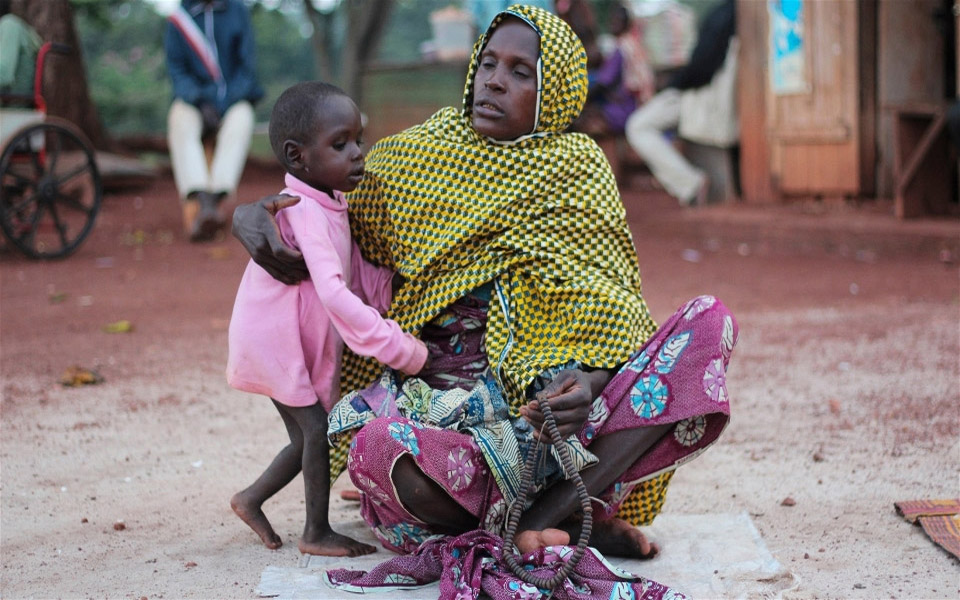
A WFP mission is on the ground in Cameroon, and has conducted screening at the Gbiti site where they found 31 percent of new arrivals at the entry point are acutely malnourished, of whom 11 percent are in a state of severe acute malnutrition, Byrs said. Screening at all other sites confirmed the dire situation, and acute malnutrition has been observed among school-age children.
According to UNHCR, in a report on its website, most of the people arriving in Gbiti are exhausted and in a precarious physical condition after fleeing brutal attacks on their homes by armed elements. Many are suffering from deep cuts or bullet wounds, but they count themselves lucky to be alive.
UNHCR and its partners closely monitor the thousands of people crossing at Gbiti, keeping an eye out for people in need of medical assistance, especially malnutrition, but also physical injuries.
Up to 2,000 people a week, mostly women and children, reach Cameroon through more than 30 entry points along a 700-kilometre stretch of border.
WFP’s Byrs said in May some 63,000 beneficiaries with were assisted and general food distribution at entry points and sites were complete. More than 30,000 Central African refugees located in transit sites had received 30-day food rations, and another 30,000-strong CAR refugees based in other sites had received those rations as well.
The percentage of IDPs intending to relocate to another region within Central African Republic had also been steadily increasing, from 4.6 percent in March 2014 to nine percent in April 2014 to 11 percent in the latest survey, according to the International Organization for Migration (IOM).
The 28 May attack on the Notre Dame de Fatima had provoked the displacement of 22,000 people, including 9,000 of whom had been taking refuge at the church, had forced that population to move to nine other displacement sites, quickly straining the limited resources at these sites in terms of shelter, water, sanitation and food, IOM said.
(Malnutrition and diseases have plagued women and children who have trekked for months to escape the escalating violence in Central African Republic into neighbouring Cameroon. Photo: IRIN/Otto Bakano)
Support Our Journalism
We cannot do without you.. your contribution supports unbiased journalism
IBNS is not driven by any ism- not wokeism, not racism, not skewed secularism, not hyper right-wing or left liberal ideals, nor by any hardline religious beliefs or hyper nationalism. We want to serve you good old objective news, as they are. We do not judge or preach. We let people decide for themselves. We only try to present factual and well-sourced news.
Support objective journalism for a small contribution.



Latest Headlines
Italy PM Meloni announces big school plan: Burqa, hijab ban and cap on foreign students
Sun, Sep 20 2026
North Korea fires two missiles toward East Sea, South Korea confirms
Sun, Sep 20 2026
Houthis claim Saudi F-15 shot down as Mecca drone row escalates
Wed, Sep 16 2026