


Burundi: UN expert urges defence of human rights activists to promote transparency
In a press release issued by the UN Office of the High Commissioner for Human Rights (OHCHR), the expert, Michel Forst, emphasized that threats and defamation campaigns by certain media outlets weigh on human rights defenders, who also report a high number of cases of physical threats, anonymous phone calls, assaults, arbitrary arrest and judicial harassment.
“I was very struck by the incredible vitality and professionalism of civil society in Burundi despite the difficult environment in which they work,” Mr. Forst said.
“They face serious obstacles that can amount to violations of their rights and fundamental freedoms, as well as their legitimate right to promote and protect human rights,” he added.
The Special Rapporteur stressed that while Burundi is fortunate to have a “dynamic” civil society and a “bold and free” press, the country’s public authorities attempt to restrict their freedom of expression by accusing them of being opposition actors when they report on events or testimonies questioning State institutions.
He said he shared his concerns with the Government regarding provisions of the law on the press that are contrary to international obligations. In particular, he noted the requirement that journalists reveal their sources, which would limit effective enjoyment of freedom of expression.
Mr. Forst highlighted the cases of the arrests and repeated threats made against certain journalists and radio stations dealing with politically sensitive topics, such as the allegations of arms distribution or the “controversial” methods of issuing identity cards.
In particular, he noted that the arrest and detention this past May of Pierre Claver Mbonimpa, a human rights defender, and the disbarment of Isidore Rufyikiri, the president of the Bar, constitute an “unacceptable escalation of the harassment of defenders” by the State’s authorities.
“A free, independent, and occasionally impertinent press, able to expose abuses of power and corruption, is essential to preserve civil liberties and to promote transparency and foster broad participation in public life,” Mr. Forst said.
Freedom of assembly and demonstration is guaranteed by the Constitution of Burundi, but in practice only protests in favour of the Government are reportedly authorized, while all others are “systematically prohibited,” the Special Rapporteur said.
“By adopting an abusive interpretation of the concept of public order, in effect, the authorities muzzle freedom of assembly and demonstration in public spaces,” Mr. Forst said.
The Special Rapporteur also pointed out that the draft law on associations being considered by Parliament includes provisions that hamper the creation and development of associations and that would “imperil the very principle of free association.”
The approval or annual renewal of such provisions poses a threat to the sustainability of certain associations, he said. In addition, he stressed that the appointment of the heads of associations by the Minister of the Interior and his power to suspend the activities of an association are contrary to international norms.
The Special Rapporteur will present his conclusions in a report to the UN Human Rights Council.
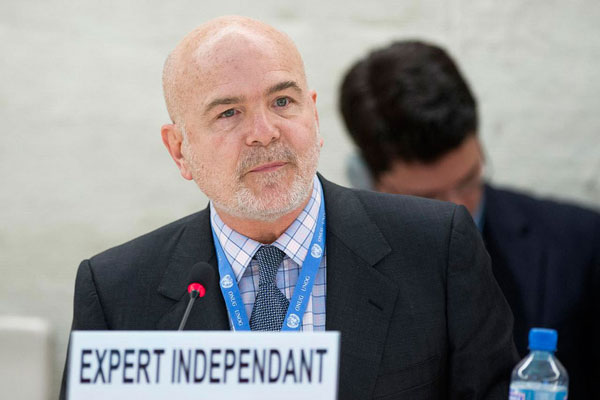
Independent Expert on Human Rights Michel Forst. Photo: Jean-Marc Ferré
Support Our Journalism
We cannot do without you.. your contribution supports unbiased journalism
IBNS is not driven by any ism- not wokeism, not racism, not skewed secularism, not hyper right-wing or left liberal ideals, nor by any hardline religious beliefs or hyper nationalism. We want to serve you good old objective news, as they are. We do not judge or preach. We let people decide for themselves. We only try to present factual and well-sourced news.
Support objective journalism for a small contribution.


