


At UN conference, education takes centre-stage in planning for a sustainable future
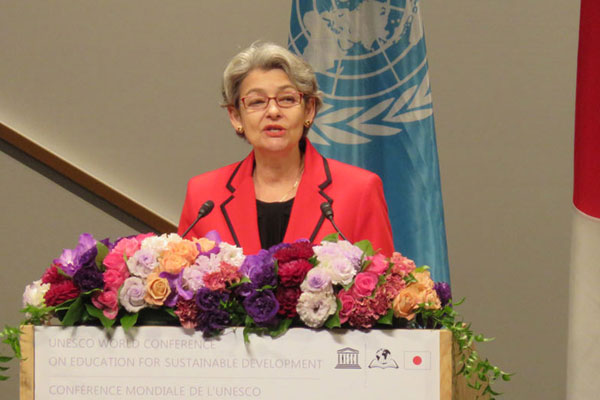
“To achieve sustainable development, technology, political regulations and financial incentives will not suffice – we need to change the way that we think and act, as individuals and as societies,” UNESCO Director-General, Irina Bokova, told delegates at the World Conference on Education for Sustainable Development (ESD).
“This is the aim of education for sustainable development,” she added.
More than 1,000 participants have gathered in the Japanese port city to take stock of the achievements of the UN Decade of ESD, which ran from 2005 to 2014, and address the issues that will confront the international community in the years to come.
Lending his support to the Conference in a video message , UN Secretary-General Ban Ki-moon called for sustainability to be “built into everything we do” and suggested that education was “the starting point” for a successful and sustainable future.
“Boys and girls must learn about global citizenship, to prepare them for the responsibility of safeguarding our common future,” Ban said.
“There is no Plan B because there is no Planet B.”
As part of its overall assessment of the UN Decade of ESD, UNESCO has presented the Conference with a report entitled Shaping the Future We Want , which analyzes the impact of ESD initiatives across the world.
Based on questionnaires responded by 70 countries, the document reports that two-thirds of the countries concerned have already a national ESD strategy or plan in place, indicating “an increased global recognition that education is a critical tool for moving societies towards sustainable development,” a UNESCO press release said.
Among the issues highlighted in the report, UNESCO underscores the need to align education with sustainable development to ensure that education supports sustainable development objectives, and a “widespread, overt and sustained political support” to make the transition from creating an enabling environment to achieving actual changes in curriculum and educator practice at all levels of education.
Writing in the The Huffington Post in an op-ed published to coincide with the opening of the Conference, Bokova affirmed the importance of ESD as a “transformative” tool, adding that it remained an “absolute priority” as the international community moved forward in preparing a new development agenda around a set of sustainable development goals (SDGs).
“Focusing on technology and financial incentives will not suffice as we strive to meet the challenge of a growing population of seven billion in a world with finite natural resources,” she wrote.
“Education has a major role to play in helping us apply the values, skills and knowledge of sustainable development to local, national and international development decisions, in order to solve the complex problems that we face.”
The World Conference – attended by delegates from over 100 countries – will run until 12 November
UNESCO Director-General Irina Bokova speaking at the opening of the World Conference on Education for Sustainable Development (ESD) in Aichi-Nagoya, Japan. Photo: UNESCO
Support Our Journalism
We cannot do without you.. your contribution supports unbiased journalism
IBNS is not driven by any ism- not wokeism, not racism, not skewed secularism, not hyper right-wing or left liberal ideals, nor by any hardline religious beliefs or hyper nationalism. We want to serve you good old objective news, as they are. We do not judge or preach. We let people decide for themselves. We only try to present factual and well-sourced news.
Support objective journalism for a small contribution.


