


At global food conference, UN officials sound the call for better global nutrition
In a video message delivered to the International Conference on Nutrition – organized by the UN Food and Agriculture Organization (FAO) and World Health Organization (WHO) –Secretary-General Ban Ki-moon observed that while “a great deal of progress” had been made since his Zero Hunger Challenge was first issued, the world needed to “redouble” its efforts in eliminating hunger and improving nutrition.
“This Conference marks a new stage in our quest to banish global hunger and malnutrition for good,” Mr. Ban told the gathered delegates. “I know from my own country’s experience the crippling effect that hunger and malnutrition can have.”
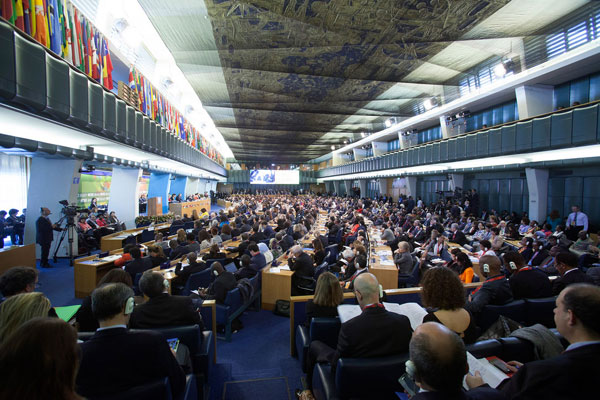
The Conference was inaugurated with the immediate adoption of the Rome Declaration on Nutrition and a Framework for Action, as more than 90 ministers and hundreds of government officials agreed on recommendations for policies and programmes to address nutrition across multiple sectors.
According to an FAO press release, the Declaration “enshrines the right of everyone to have access to safe, sufficient and nutritious food” while committing governments to preventing malnutrition and hunger. At the same time, the Framework for Action sets out 60 recommended actions that governments may incorporate into their national nutrition, health, and agriculture plans.
Mr. Ban noted that more than 100 developing countries across Africa, Latin America, and the Caribbean had committed to ending hunger by a 2025 deadline while 54 countries had already taken measures recognizing the importance of nutrition to their social and economic development. Many countries, he added, were also responding to what he described as “the increasing challenge of obesity.”
While the prevalence of hunger has fallen by 21 percent since 1990-92, over 800 million people in the world still go hungry, the UN agriculture agency has reported. Over two billion people are affected by micronutrient deficiencies, or “hidden hunger,” due to inadequate vitamins or minerals. Undernutrition, meanwhile, is linked to almost half of all child deaths under five years of age, some 2.8 million per year.
Against this backdrop, the scourge of obesity also claims victims with around half a billion people now obese, and three times as many overweight. Some 42 million children under the age of five are already overweight. Moreover, different forms of malnutrition often overlap, with people living in the same communities-sometimes even in the same household-suffering from hunger, micronutrient deficiencies and obesity.
Overall, the FAO notes, half the world’s population is affected by some sort of malnutrition.
“We have the knowledge, expertise and resources needed to overcome all forms of malnutrition,” FAO Director-General Jose Graziano da Silva confirmed in his message to the Conference. “Governments must lead the way, but the push to improve global nutrition must be a joint effort, involving civil society organizations and the private sector.”
He cautioned that while both the Rome Declaration and Framework for Action were “the starting point of our renewed efforts to improve nutrition for all,” they were not “the finishing line.”
“Our responsibility is to transform the commitment into concrete results,” he concluded.
The Conference, which runs until 21 November, will also seek to address the way food is produced, processed, distributed, marketed and prepared for human consumption as healthy diets are considered central to establishing a stable bulwark against malnutrition. As a result, governments will be encouraged to support local food production and processing, especially by smallholder and family farmers.
“The world’s food system – with its reliance on industrialized production and globalized markets – produces ample supplies, but creates some problems for public health,” WHO Director-General, Dr Margaret Chan, explained.
“Part of the world has too little to eat, leaving millions vulnerable to death or disease caused by nutrient deficiencies,” she continued. “Another part overeats, with widespread obesity pushing life-expectancy figures backwards and pushing the costs of health care to astronomical heights.”
Governments will be urged to tackle the widespread use of trans-fats, saturated fats, sugars and salt in foods and drinks through a series of necessary regulatory and voluntary instruments without which, the FAO suggests, it would be difficult to protect consumers from the noxious elements found in many packaged goods found around the world.
“Global nutrition problems require global solutions,” the UN agency remarked in its press release, “while nutrition deserves much greater attention on the international development agenda.”
Opening Ceremony of the Second International Conference on Nutrition (ICN2), at FAO Headquarters in Rome, Italy. Photo: FAO/Giulio Napolitano
Support Our Journalism
We cannot do without you.. your contribution supports unbiased journalism
IBNS is not driven by any ism- not wokeism, not racism, not skewed secularism, not hyper right-wing or left liberal ideals, nor by any hardline religious beliefs or hyper nationalism. We want to serve you good old objective news, as they are. We do not judge or preach. We let people decide for themselves. We only try to present factual and well-sourced news.
Support objective journalism for a small contribution.


