


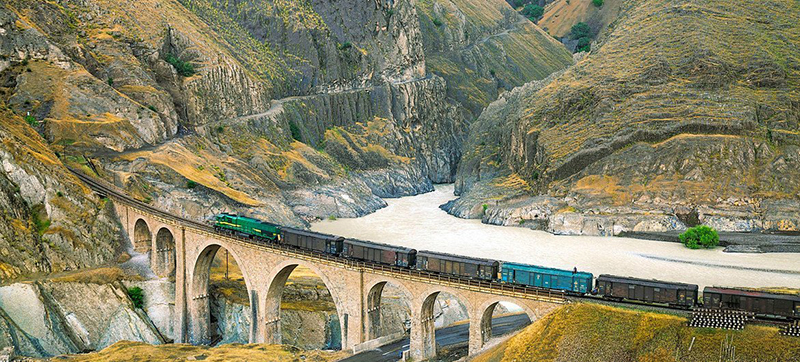
Assembly President calls for massive investment in sustainable infrastructure
The President of the UN General Assembly on Thursday underscored the critical need for resilient infrastructure if the world is the reach the 17 Sustainable Development Goals (SDGs) by the 2030 deadline.
In a special meeting dedicated to building resilience and promoting sustainable development through infrastructure connectivity, Dennis Francis emphasized the importance of quality and endurance.
“Quality, reliable, sustainable and resilient infrastructure – including regional and transborder infrastructure – is important to sustain trade and commerce, facilitate effective transportation, connect us to virtual grids, maintain energy flows, and make populations safer against natural hazards,” he said.
Highlighting recent shocking failures such as the collapse of the Francis Scott Key Bridge in Baltimore, Maryland, Mr. Francis pointed out the extensive economic impact of such disasters, affecting national and global supply chains.
He stressed the urgency of adapting transport infrastructure to withstand both human-induced and natural disasters, exacerbated by climate change.
Tweet URL
Special cases
In particular, he cited the impacts on countries grappling through no fault of their own, with acute challenges – the Least Developed Countries (LDCs), the Landlocked Developing Countries (LLDCs) and the small island developing States (SIDS).
They are faced with unique geographical and economic conditions, which make them particularly vulnerable to infrastructure damage from natural hazards.
“The SIDS, in particular, often confront more intense and frequent natural hazards – making their infrastructure susceptible to damage and destruction. In some instances, the annual cost of damage amounting to almost 10 percent of a country’s gross domestic product (GDP),” Mr. Francis said.
In his address, the Assembly President also cited the opportunities presented by the upcoming fourth International Conference on Small Island Developing States (SIDS4) and third UN Conference on Landlocked Developing Countries (LLDC3).
LLDC3 was due to take place in June but will now be rescheduled to a later date, organizers said on Thursday.
“There is an increasing urgency to reflect on and indeed to address these regional and global challenges,” he said.
Assembly’s sustainability week
The high-level event on sustainable infrastructure, part of the General Assembly’s first ever Sustainability Week, followed Monday’s deliberations on debt sustainability, sustainable tourism on Tuesday and transport on Wednesday.
On Friday, the General Assembly will mark the completion of the UN Decade of Sustainable Energy for All. Discussions will focus on efforts to further accelerate the implementation of SDG 7 on affordable, reliable and sustainable energy.
Support Our Journalism
We cannot do without you.. your contribution supports unbiased journalism
IBNS is not driven by any ism- not wokeism, not racism, not skewed secularism, not hyper right-wing or left liberal ideals, nor by any hardline religious beliefs or hyper nationalism. We want to serve you good old objective news, as they are. We do not judge or preach. We let people decide for themselves. We only try to present factual and well-sourced news.
Support objective journalism for a small contribution.


