September 21, 2026 04:28 am (IST)

Follow us:


 Burkina Faso
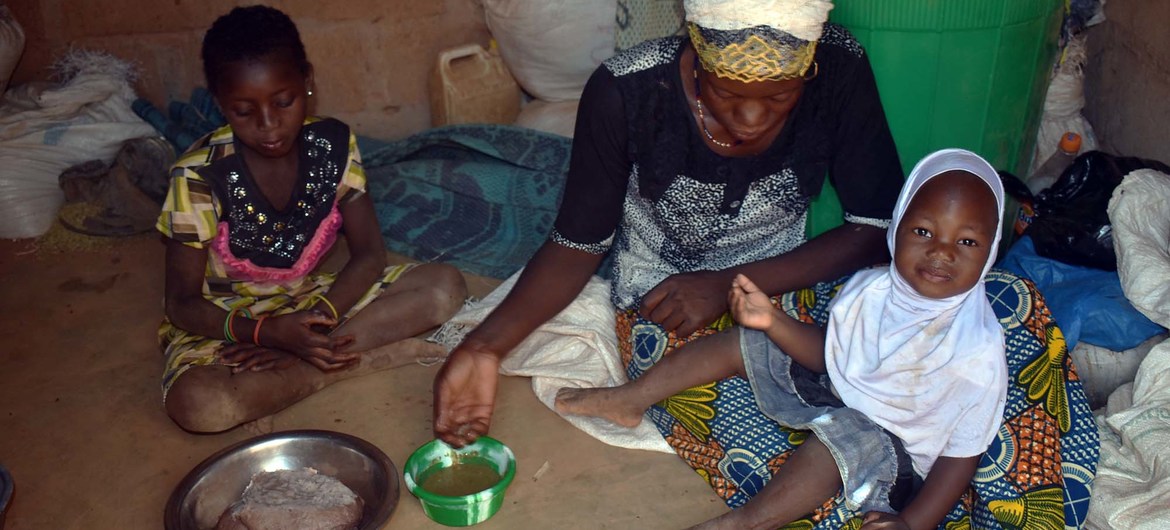
As Burkina Faso grapples with COVID-19, new UN data reveals ‘alarming deterioration’ in food security
New York: An estimated 3.3 million people in Burkina Faso are facing acute food insecurity, two United Nations agencies warned on Friday.
Citing alarming new data, the Food and Agriculture Organization (FAO) and the World Food Programme (WFP), stressed that “urgent and sustained action” is needed to address the worsening food and nutrition situation throughout the country.
Hunger trending upward
Since the situation in Burkina Faso was last assessed in March, acute food insecurity has increased more than 50 per cent, according to the latest analysis.
And in a country already reeling from conflict and climate change, the UN survey points out that COVID-19 has intensified people’s inability to earn money to cover their daily needs.
“The COVID-19 pandemic is further exacerbating a crisis that was already deteriorating at a worrying pace, pushing more and more people into severe food crisis and acute food insecurity,” said Dauda Sau, FAO Representative in Burkina Faso.
Emergency phase
Meanwhile, the provinces of Oudalan and Soum in the Sahel region have been driven into the emergency phase of food insecurity, as defined by the analysis.
Some three per cent of people in these northern areas are said to be experiencing catastrophic levels of acute food insecurity and facing extreme food consumption gaps, which are also resulting in alarming levels of acute malnutrition.
“We’re seeing an alarming deterioration in food security across the worst-hit parts of the country,” said David Bulman, WFP Country Director and Representative in Burkina Faso.
And many of those worst affected have been displaced from their homes by fighting in the region.
“We need to take immediate action to reverse this trend in the two provinces. It would be nothing short of a disaster were a whole generation to be crushed by conflict, displacement and hunger,” he added.
Changing the course
Many of those most at risk are subsistence farmers and livestock herders.
While urgent humanitarian life-and livelihood-saving assistance is essential to address immediate needs, so too are longer-term investments in rural livelihoods and social services which, experts say can help reinforce social cohesion and contribute to peace.
“We can reverse this trend if we act now by supporting the Government to protect livelihoods, rapidly increase local food production and availability, and support rural populations to access food,” the FAO Representative stated.
Both FAO and WFP have been responding to the crisis in Burkina Faso by providing food assistance coupled with livelihood protection and support for displaced people and the host communities that receive them.
Support Our Journalism
We cannot do without you.. your contribution supports unbiased journalism
IBNS is not driven by any ism- not wokeism, not racism, not skewed secularism, not hyper right-wing or left liberal ideals, nor by any hardline religious beliefs or hyper nationalism. We want to serve you good old objective news, as they are. We do not judge or preach. We let people decide for themselves. We only try to present factual and well-sourced news.
Support objective journalism for a small contribution.



Latest Headlines
Italy PM Meloni announces big school plan: Burqa, hijab ban and cap on foreign students
Sun, Sep 20 2026
North Korea fires two missiles toward East Sea, South Korea confirms
Sun, Sep 20 2026
Houthis claim Saudi F-15 shot down as Mecca drone row escalates
Wed, Sep 16 2026