


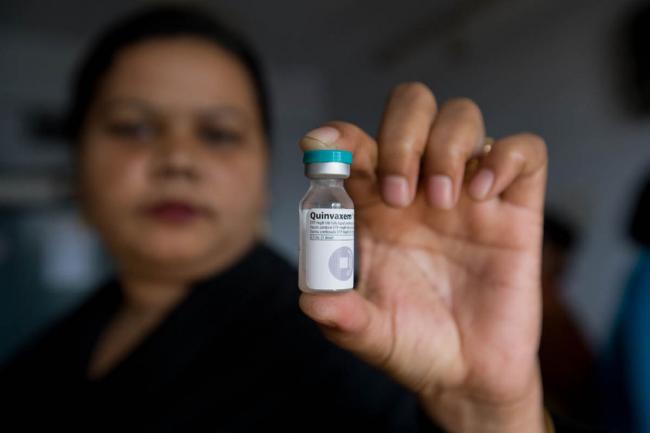
‘Large majority’ of millions living with hepatitis have no access to testing or treatment – UN agency
According to the UN World Health Organization (WHO)’s 2017 Global Hepatitis Report, just 9 per cent of all hepatitis B virus (HBV) and hepatitis C virus (HCV) infections were diagnosed in 2015. An even smaller fraction – merely 8 per cent and 7 per cent– of those diagnosed with HBV and HCV, respectively, started curative treatment during that year.
“Viral hepatitis is now recognized as a major public health challenge that requires an urgent response,” said Margaret Chan, the Director-General of WHO, in a news release announcing the findings.
“Vaccines and medicines to tackle hepatitis exist, and [we] are committed to helping ensure these tools reach all those who need them.”
The report also revealed that increased coverage of HBV vaccinations among children have contributed substantially to preventing deaths from that virus.
Globally, 84 per cent of children born in 2015 received the three recommended doses of HBV vaccine.
However, an estimated 257 million people, mostly adults born before the introduction of the HBV vaccine, were living with chronic HBV infection in 2015. There is also currently no vaccine against HCV, and access to treatment for both HBV and HCV is low.
HBV infection requires lifelong treatment, and Hepatitis C can be cured within a relatively short time using the correct medicines, making the need for testing and treatment all the more important.
“We are still at an early stage of the viral hepatitis response, but the way forward looks promising,” said Gottfried Hirnschall, Director of WHO’s Department of HIV and the Global Hepatitis Programme, adding: “More countries are making hepatitis services available for people in need – a diagnostic test costs less than $1 and the cure for HCV can be below $200.”
Western Pacific, African regions bear greatest burdens
Findings have also revealed that Hepatitis B levels vary across the planet. WHO’s Western Pacific Region (115 million people) and its African Region (60 million people) have the highest number of such patients. These roughly equate to 6.2 per cent and 6.1 per cent of their respective total populations.
Similarly, HCV prevalence by regions varies from about seven million (in WHO Americas Region) to 15 million (in the UN agency’s Eastern Mediterranean Region).
The report has also shown that that despite challenges, some countries have made strides in scaling-up hepatitis services.
China, for instance, achieved a high coverage of nearly 96 per cent for the timely birth dose of HBV vaccines, and reached the Hepatitis B control goal of less than one per cent prevalence in children under the age of five in 2015.
Mongolia, too, has improved the uptake of hepatitis treatment by including HBV and HCV medicines in its National Health Insurance Scheme, which covers 98 per cent of its population.
Similarly, generic competition among medicines has also contributed substantially, in Egypt, for example, the price of a 3-month cure for Hepatitis C has reduced to less than $200 (in 2016) from $900 (in 2015) also, in Pakistan, the same course currently costs as little as $100.
WHO’s Global Health Sector Strategy on viral hepatitis aims to test 90 per cent and treat 80 per cent of people with HBV and HCV by 2030.
Photo: UNICEF/Shehab Uddin
Source: www.justearthnews.com
Support Our Journalism
We cannot do without you.. your contribution supports unbiased journalism
IBNS is not driven by any ism- not wokeism, not racism, not skewed secularism, not hyper right-wing or left liberal ideals, nor by any hardline religious beliefs or hyper nationalism. We want to serve you good old objective news, as they are. We do not judge or preach. We let people decide for themselves. We only try to present factual and well-sourced news.
Support objective journalism for a small contribution.


