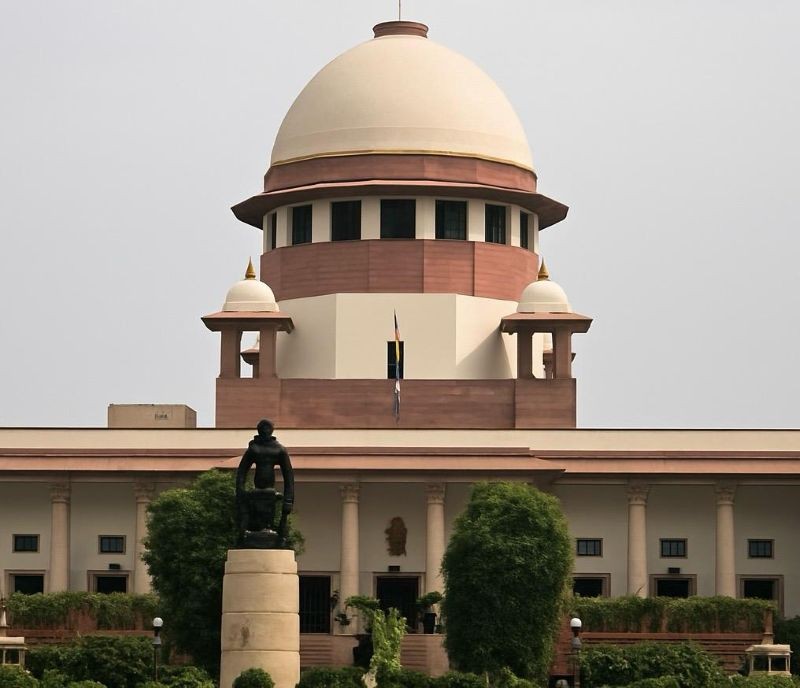
SC says president, governors can’t be given deadlines to clear bills, calls earlier verdict 'contrary to constitution'
In a major constitutional clarification, the Supreme Court on Thursday ruled that neither the president nor state governors can be bound by judicially imposed timelines when approving bills.
A five-judge Constitution bench held that their actions are not “justiciable” at the pre-assent stage, and that courts can intervene only after a bill becomes law.
The ruling came after President Droupadi Murmu sought the court’s opinion under Article 143, following a two-judge bench verdict in the Tamil Nadu Governor case.
The verdict effectively set deadlines for governors and the President to act on bills, an approach the Constitution bench has now rejected.
The President had asked whether courts could prescribe time limits for governors under Article 200, or scrutinise the President’s discretionary decisions under Article 201.
She also raised the question of whether a governor is bound by the Council of Ministers’ advice while exercising options available under Article 200.
Her queries cited Article 361, which protects the President and Governors from being answerable to courts for actions taken in office.
Chief Justice of India BR Gavai, heading the bench, said imposing timelines would be “strictly contrary” to the Constitution’s design. Articles 200 and 201, he said, are deliberately framed with “elasticity” to allow constitutional authorities to act in varied political and legislative contexts.
Judges Surya Kant, Vikram Nath, PS Narasimha, and AS Chandurkar were also on the bench.
The bench categorically struck down the concept of “deemed assent” endorsed by the earlier two-judge bench, calling it a judicial “takeover” of executive functions.
“Deemed consent… at the expiry of a judicially set timeline… is impermissible within the contours of our written Constitution,” the court said.
The Tamil Nadu case
On April 8, a two-judge bench had declared 10 bills—held up by Governor RN Ravi—as having “deemed assent,” using powers under Article 142.
The DMK government had accused the Governor of indefinitely sitting on legislation.
The court's ruling had also warned Governors to respect democratic norms and avoid obstructing legislatures.
It also said the Union government must refrain from judging the constitutional validity of Bills and, when in doubt, refer such questions to the Supreme Court under Article 143.
The verdict drew criticism from some in the ruling establishment, who described it as judicial overreach.
What the Constitution bench clarified
Responding to the President’s reference, the bench said Articles 200 and 201 intentionally provide flexibility, and courts cannot impose rigid timelines.
Judicial review is part of the Constitution’s basic structure, but cannot override the separation of powers.
While courts cannot examine the merits of a Governor’s actions under Article 200, prolonged, unexplained, and indefinite inaction may invite “limited judicial scrutiny.”
The court stressed that every constitutional authority is part of an interdependent system: “They depend on each other to keep the Constitution humming, and thus, working.”
Support Our Journalism
We cannot do without you.. your contribution supports unbiased journalism
IBNS is not driven by any ism- not wokeism, not racism, not skewed secularism, not hyper right-wing or left liberal ideals, nor by any hardline religious beliefs or hyper nationalism. We want to serve you good old objective news, as they are. We do not judge or preach. We let people decide for themselves. We only try to present factual and well-sourced news.
Support objective journalism for a small contribution.