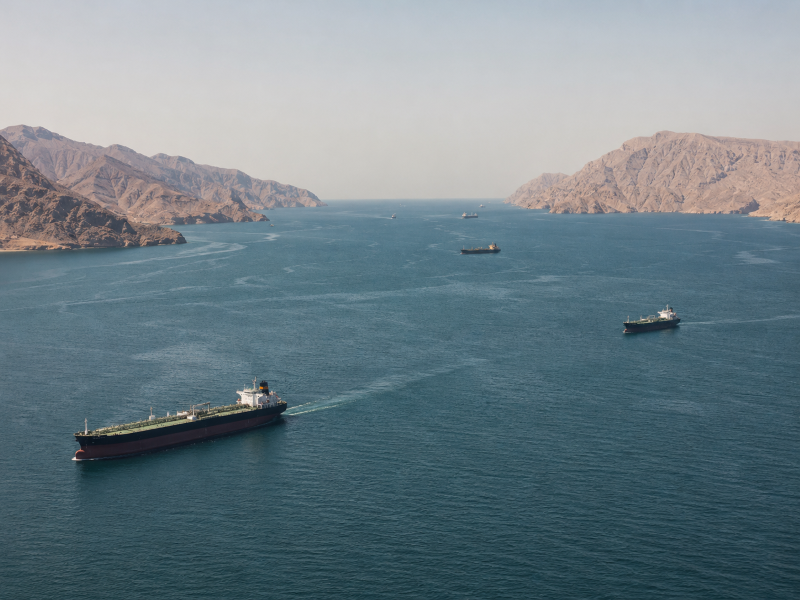
Most India-bound ships 'go dark' in Strait of Hormuz amid fears of Iranian attacks
A majority of commercial vessels sailing to India through the Strait of Hormuz are switching off their tracking systems, apparently to reduce the risk of being targeted amid heightened tensions involving Iran, according to maritime intelligence firm Kpler.
The data shows that nearly 62 per cent of tankers and cargo vessels travelling from the Persian Gulf to India stopped transmitting their location and identity while transiting the strait, a practice known in the shipping industry as "going dark".
Most India-bound ships stopped broadcasting their location
Between May 1 and June 25, a total of 73 India-bound ships passed through the Strait of Hormuz. Of these, 45 vessels switched off their Automatic Identification System (AIS) transponders while crossing the narrow waterway, Kpler's data showed.
AIS transponders normally broadcast a ship's identity, location and destination to help ensure safe navigation.
However, vessels operating in conflict zones or high-risk waters sometimes disable the system to avoid being tracked.
Only four India-flagged vessels made the journey during the period. Two of them withheld their identity and routing information, while the other two continued broadcasting their details despite travelling through both Iranian and Oman-side shipping lanes.
Dark transits seen across both shipping routes
Kpler's broader analysis identified at least 69 India-bound vessels—including tankers and cargo ships registered under flags such as Panama, Liberia, the UAE and the Marshall Islands—that switched off their transponders while crossing the strait.
Of these, 14 sailed through the Oman-side shipping lane, while 10 used Iran-controlled traffic lanes, indicating that vessels are opting for "dark" transits regardless of the route taken.
Shipping companies appear to be exercising caution as vessels linked to countries perceived as friendly to the West or hostile to Iran are considered more vulnerable in the region.
Shipping rules have become increasingly unpredictable
Maritime conditions in the Strait of Hormuz have become increasingly uncertain since tensions escalated earlier this year.
According to shipping data, Iran has frequently altered transit guidance, with some vessels reportedly coming under attack even after receiving permission to pass through the waterway.
In mid-April, the India-flagged very large crude carrier (VLCC) Sanmar Herald was attacked near Larak Island, where Iranian authorities oversee maritime traffic.
An audio recording that surfaced after the incident reportedly captured the ship's captain saying the vessel had received clearance from the Islamic Revolutionary Guard Corps (IRGC) Navy before it was targeted.
Oman route seen as safer, but risks remain
In early May, several commercial ships began using a route closer to Oman's coastline. The corridor was later endorsed by US forces as part of an escorted transit arrangement and subsequently recognised by Oman and the International Maritime Organization (IMO).
Although the escort operations were scaled back within days, vessels have continued using the Oman-side route, with many choosing to switch off their transponders while making the passage.
Despite being viewed as relatively safer because of its proximity to Omani waters and the presence of US naval forces, the route has not been free of danger.
In mid-May, an India-flagged cargo vessel sank near Limah, Oman, following what was reported as a suspected Iranian attack, underscoring the continued risks to commercial shipping in one of the world's busiest maritime chokepoints.
Support Our Journalism
We cannot do without you.. your contribution supports unbiased journalism
IBNS is not driven by any ism- not wokeism, not racism, not skewed secularism, not hyper right-wing or left liberal ideals, nor by any hardline religious beliefs or hyper nationalism. We want to serve you good old objective news, as they are. We do not judge or preach. We let people decide for themselves. We only try to present factual and well-sourced news.
Support objective journalism for a small contribution.