Is the RSS Hindu Supremacist? Its General Secretary Hosabale Went to Washington With an Answer
At the Hudson Institute's New India Conference, RSS General Secretary Dattatreya Hosabale, the executive head of the Indian Hindu volunteer organisation, made a calm, deliberate pitch to an American audience: that the world's largest volunteer organisation is rooted in civilisational values, not supremacist ideology. IBNS reports
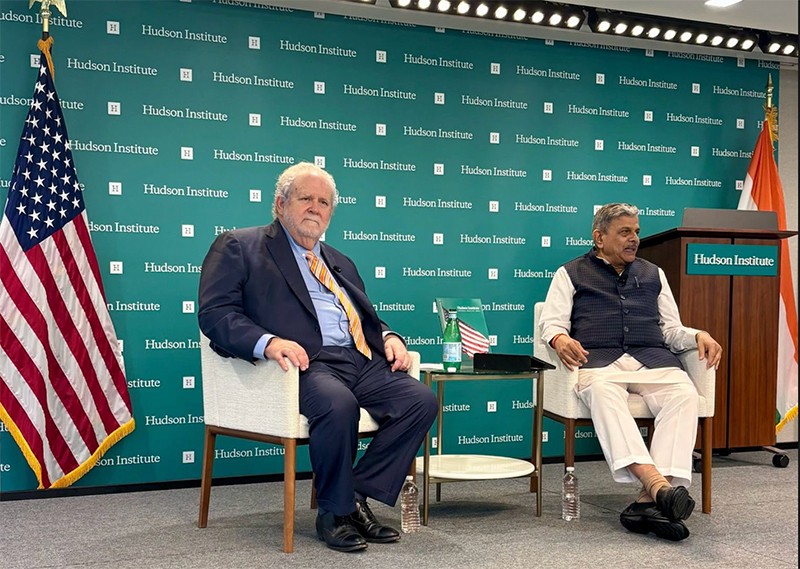
On April 23, in a wood-panelled fireside chat at one of Washington's most respected think tanks, a soft-spoken Indian organisation man sat across from historian Walter Russell Mead and fielded a question that has dogged his organisation for decades: Is the Rashtriya Swayamsevak Sangh — the RSS — the Ku Klux Klan of India?
Dattatreya Hosabale, the Sarkaryavah, or General Secretary, of the RSS, did not flinch. "Hindu philosophy and Hindu culture doesn't allow supremacy," he told the New India Conference. "We see the whole world as one family. All are our brothers and sisters. Then there is no question of supremacy."
It was a carefully chosen stage. The Hudson Institute, long associated with serious strategic thinking and close ties to American conservatism, was hosting a conference on India's evolving role in the world order. For the RSS, an organisation that rarely courts Western media and has historically been opaque to foreign audiences, the appearance was something of a departure — and a deliberate one.
"RSS is a people's voluntary movement, inspired by the cultural ethos and civilisation values of ancient India — what is generally known as Hindu philosophy and Hindu culture."
— Dattatreya Hosabale, RSS Sarkaryavah, Hudson Institute, April 23, 2026
"America's misunderstanding is not only about the RSS. America's misunderstanding about India is that it is overpopulated, full of slums, poverty, and is the land of snakes, slums and swamis. India is also a tech hub… India is the fourth-largest economy in the world," he said.
Founded in 1925 in Nagpur by Keshav Baliram Hedgewar, the RSS began as a cultural organisation in the shadow of colonial rule, its founding impulse being the idea that India's renewal depended on the moral and physical regeneration of Hindu society.
Over the course of a century, it has grown into what many describe as the world's largest volunteer-based civil society network, with millions of members participating in daily shakhas — morning drills and discussions — across every state in the country.
Within India, the RSS occupies a complex and contested place. Its critics, ranging from liberal academics to minority rights groups, point to the organization's historical association with Hindu nationalist politics, its early ideological flirtations with ideas of cultural homogeneity, and its role as the foundational ideological and organizational parent of the ruling Bharatiya Janata Party (BJP).
Its defenders — and there are many, including large numbers of ordinary citizens well beyond the political right — describe an organisation that runs schools, disaster relief networks, tribal welfare programmes, and thousands of service projects that cut across caste and class lines.
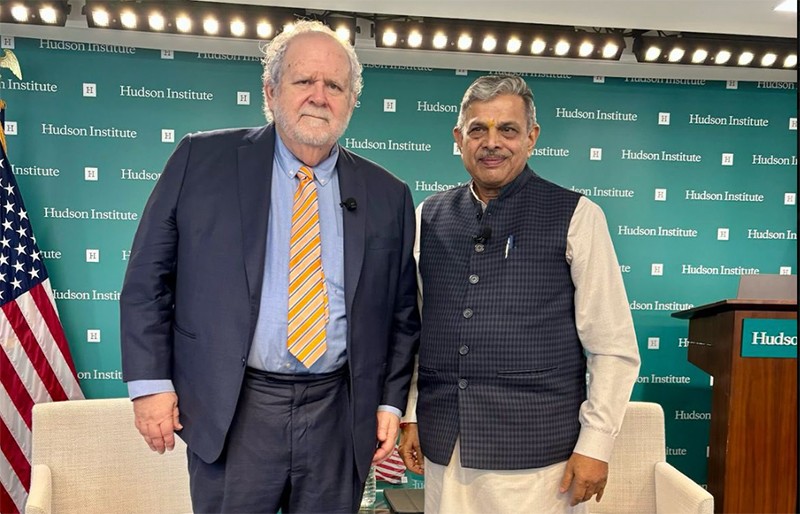 Hosabale and Mead at the Hudson Institute fireside chat. Photo: X/RSS
That breadth is central to the RSS's self-understanding, and it was front and centre in Hosabale's remarks in Washington. Rejecting the label of Hindu supremacist, he drew a distinction between supremacy — which implies domination over others — and pride in a civilisational tradition that, he argued, has historically been defined by its inclusivity. "We see the oneness in everybody," he said. "When that is the basic philosophy of Hindus, the supremacist nature cannot be there."
Hosabale also addressed the question of India's religious minorities directly, noting that the RSS conducts regular dialogues with minority communities and their leadership.
"RSS believes that continuous and comprehensive dialogue will definitely help in clearing misconceptions, misgivings, or if there are any fears, that will definitely be clarified," he said — an acknowledgement, implicit in the phrasing, that such fears do exist, and that the organisation takes them seriously enough to engage with them.
"In history, Hindus have never invaded any country or enslaved any people. Hindus have nothing to apologise for," he said.
Whether that message lands in America depends in part on who is listening. For a US audience shaped by decades of reportage that frames Hindu nationalism primarily through the lens of communal violence and minority persecution, Hosabale's articulation of Vasudhaiva Kutumbakam — the Sanskrit phrase meaning "the world is one family" — may read as aspirational or as apologetics, depending on one's priors. The RSS, for its part, seems aware that the gap between how it sees itself and how it is seen abroad is worth bridging.
The Hudson Institute appearance is part of a broader pattern of RSS outreach to international audiences in recent years — a recognition, perhaps, that as India's global stature grows, so does scrutiny of the ideological ecosystem that has shaped much of its current political leadership. Engaging with that scrutiny, rather than dismissing it, marks something of a shift in approach.
None of this resolves the substantive debates about the RSS's record and influence within India. Those debates are live, contested, and unlikely to be settled by a single fireside chat in Washington. But as a statement of intent — that the RSS is willing to enter the arena of international dialogue and make its case in the language of universal values — Hosabale's appearance at the Hudson Institute was, at minimum, a notable one.
Support Our Journalism
We cannot do without you.. your contribution supports unbiased journalism
IBNS is not driven by any ism- not wokeism, not racism, not skewed secularism, not hyper right-wing or left liberal ideals, nor by any hardline religious beliefs or hyper nationalism. We want to serve you good old objective news, as they are. We do not judge or preach. We let people decide for themselves. We only try to present factual and well-sourced news.