 India-Japan
AI, defence, energy: PM Modi, Japanese PM Takaichi unveil ambitious roadmap for a new era in India-Japan ties
New Delhi/IBNS: India and Japan on Thursday significantly expanded their strategic partnership by announcing a series of agreements covering artificial intelligence, defence technology, economic security, healthcare, critical minerals, semiconductors and clean energy.
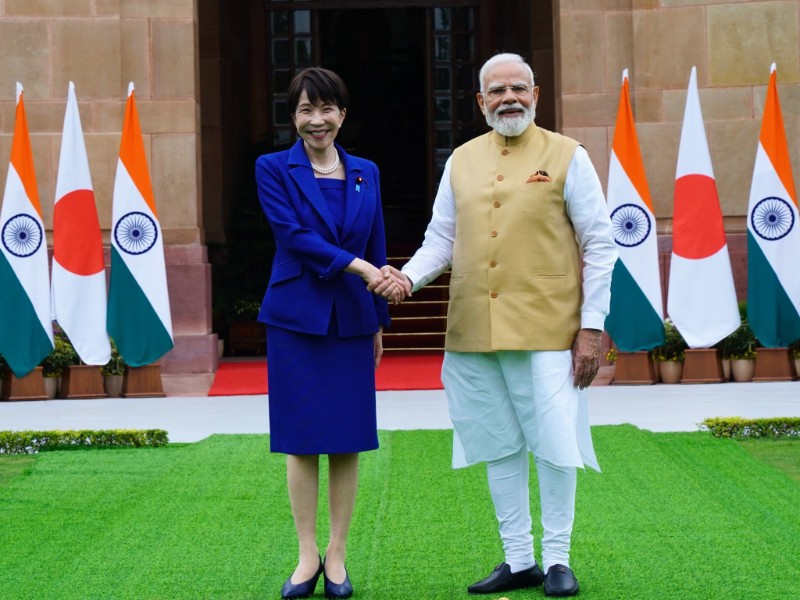
The announcements came after the 16th India-Japan Annual Summit in New Delhi, where Prime Minister Narendra Modi and Japanese Prime Minister Sanae Takaichi outlined a broader roadmap for cooperation across key sectors shaping the future global economy.
The summit marked Takaichi's first official visit to India since assuming office as Japan's Prime Minister and reflected the growing alignment between New Delhi and Tokyo on technology, resilient supply chains, regional security and economic collaboration.
Modi welcomes Takaichi
Welcoming Prime Minister Sanae Takaichi, Prime Minister Narendra Modi underlined the long-standing civilisational ties between the two countries, particularly their shared Buddhist heritage.
"It gives me great pleasure to welcome Prime Minister Sanae Takaichi to India on her first visit for the India-Japan Annual Summit. She is Japan's first female Prime Minister and a visionary, popular leader. Moreover, she hails from Japan's Nara Prefecture, a vital centre of the shared Buddhist heritage between India and Japan," Modi said.
The leaders described the summit as another milestone in strengthening one of Asia's most significant strategic partnerships.
AI 'key pillar' of partnership
Technology cooperation emerged as one of the summit's central themes, with both governments issuing a joint statement on artificial intelligence and facilitating multiple agreements between Indian and Japanese institutions working in the AI sector.
"Prime Minister Takaichi and I believe that a technology partnership will become the strongest pillar of our cooperation," Modi said.
"Several key institutions within the Indian AI ecosystem have also signed agreements with their Japanese partners today. The convergence of Japan's precision technology and India's software capabilities will impart new momentum and strength to global AI development."
Beyond AI, both countries agreed to strengthen collaboration in semiconductors, quantum technologies, advanced manufacturing, next-generation mobility and critical minerals, sectors regarded as essential for future economic resilience and technological competitiveness.
First joint defence co-development project
Defence cooperation received a significant boost with the announcement of the first India-Japan defence co-development initiative involving the Naval Radio Antenna 'Unicorn'.
According to Modi, the agreement represents a new phase in bilateral defence collaboration.
"This project will open a new chapter in our defence technology partnership. We will now jointly develop defence technologies that strengthen regional peace, maritime security and the rules-based order," he said.
The leaders reaffirmed their commitment to strengthening maritime security and promoting a free, open and rules-based Indo-Pacific.
Healthcare, pharma, biotech cooperation expands
India and Japan also agreed to deepen collaboration in pharmaceuticals, biotechnology and medical devices.
Modi said combining India's manufacturing scale with Japan's technological expertise could contribute to improving global healthcare.
"By combining India's scale with Japan's quality, we will work towards delivering affordable, reliable and advanced health solutions to the world," he said.
The healthcare partnership aims to support innovation while enhancing global health security.
Investment target and economic security roadmap
Economic cooperation remained another major focus of the summit.
Prime Minister Modi said bilateral investment ties continue to strengthen, with approximately 120 new business agreements concluded over the past year.
"The India-Japan investment partnership is steadily strengthening. Over the past year, around 120 new business agreements have been concluded, which will bring over 10 billion dollars in Japanese investment to India," he said.
"Our goal is clear: to attract 10 trillion yen in investment from Japan to India and to double the number of Japanese companies operating in India over the next decade."
The two countries also adopted a comprehensive roadmap on economic security aimed at strengthening resilient supply chains and reducing vulnerabilities in critical sectors.
Focus on 'clean transition'
The summit also saw the launch of the India-Japan Bio-gas Initiative, under which 1,000 biogas and organic fertiliser plants will be established across India.
According to Modi, the initiative will contribute to energy security, environmental sustainability and rural livelihoods while supporting India's clean energy transition.
The agreement adds another dimension to the growing energy partnership between the two countries as they seek to accelerate the adoption of sustainable technologies.
Shared vision for Indo-Pacific
Regional security and the Indo-Pacific remained central to the leaders' discussions.
Modi said both nations, among the world's leading economies, share a common vision for maintaining a free, prosperous and rules-based Indo-Pacific region.
"Today, both India and Japan are among the world's largest economies. A free, prosperous and rules-based Indo-Pacific is our shared priority," he said.
"As the region's largest democratic and market economies, we have undertaken several significant initiatives today. Together, these will pave the way for peace, stability and progress across the entire region."
According to experts, the latest agreements highlight the steady evolution of India-Japan relations from a partnership traditionally centred on infrastructure development into a broader strategic collaboration spanning advanced technologies, defence manufacturing, investment, energy security, healthcare and regional stability.
Support Our Journalism
We cannot do without you.. your contribution supports unbiased journalism
IBNS is not driven by any ism- not wokeism, not racism, not skewed secularism, not hyper right-wing or left liberal ideals, nor by any hardline religious beliefs or hyper nationalism. We want to serve you good old objective news, as they are. We do not judge or preach. We let people decide for themselves. We only try to present factual and well-sourced news.
Support objective journalism for a small contribution.