 Social Media
UN report highlights how social media affects mental health, well-being of young girls
Digital technologies and algorithm-driven software - especially social media - present high risks of privacy invasion, cyberbullying and distraction from learning to young girls, according to the UN Educational, Scientific and Cultural Organization’s (UNESCO) latest Global Education Monitor (GEM) report released on Thursday.
In an interview with UN News, Senior Policy Analyst from the GEM report team Anna D’addio said the report examines the issue of technology in education through a gender lens.
She said the report highlights progress in the reversal of discrimination against girls over the past two decades but also exposes the negative impact of technology on girls' education opportunities and outcomes.
Harassment online
“Girls on social media are much more exposed to different forms of harassment. Cyber cyberbullying is much more frequent among girls than among boys,” Ms. D’Addio said.
“It's something that affects their well-being, and their well-being is important for learning”, she added.
Guterres stresses internet access
The report coincides with the UN telecoms agency (ITU) led International Girls in ICT Day.
In a post on his Twitter account, the Secretary-General called for more equipment and support for girls in the Information and Communication Technology field, pointing out that fewer women than men have access to the internet – and that stands in their way of getting an equal opportunity for work.
Mental health, body disorders
Based on the report’s findings, social media exposes young girls to a range of unsuitable video material including sexual content - and the promotion of unhealthy and unrealistic body standards that negatively affect mental health and wellbeing.
It was reported that adolescent girls are twice as likely to feel lonely than boys and suffer from an eating disorder.
“There is increasing evidence that shows that increased exposure to social media is related to mental health problems, eating disorders and many other issues that condition and distract social media users, and particularly girls, from education which affects their academic achievement,” D’Addio said.
Instagram has reportedly accounted for 32 per cent of teenage girls' feeling worse about their bodies after consuming the platform’s content, according to a Facebook statistic cited in the report.
The Senior Policy Analyst said social media usage can have positive effects on young girls, especially when used to increase knowledge and raise awareness on social issues.
“I think what is important is…to teach how to use social media and technology,” Ms. D’Addio said.
Girls in STEM
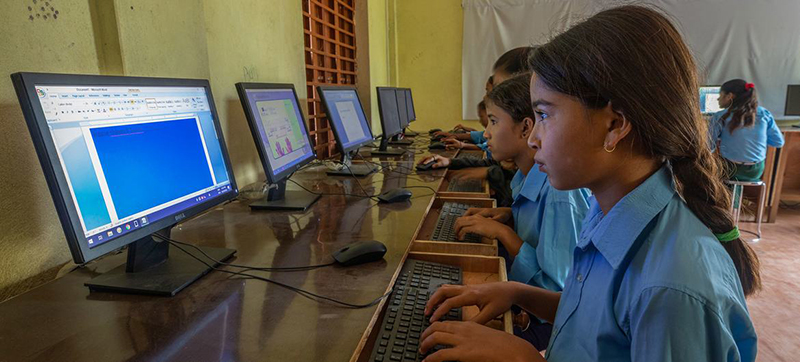
She said the report calls attention to the fact that girls are at a disadvantage in accessing science, technology, engineering and mathematical (STEM) careers which shows a lack of diversity in the production and development of cutting edge tech.
Data from the UNESCO Institute for Statistics (IUS) showed that women only make up 35 per cent of tertiary education STEM graduates globally, and only hold 25 per cent of science, engineering and information and communication technology (ICT) jobs.
“There are still too few girls and women that choose…the STEM subjects and work there,” the Senior Policy Analyst said.
She said having more diversity will allow stronger contributions to science and developments without bias.
How does it get better?
The report’s results reveal the need for a greater investment in education and smarter regulation of digital platforms.
D’Addio said UNESCO is constantly working on remedying the exclusion of girls' access and attainment to education that remains by advocating for policies that make the education system more inclusive, and “promoting laws and regulations that guarantee equal access to education for girls and protect them from discrimination.”
Support Our Journalism
We cannot do without you.. your contribution supports unbiased journalism
IBNS is not driven by any ism- not wokeism, not racism, not skewed secularism, not hyper right-wing or left liberal ideals, nor by any hardline religious beliefs or hyper nationalism. We want to serve you good old objective news, as they are. We do not judge or preach. We let people decide for themselves. We only try to present factual and well-sourced news.
Support objective journalism for a small contribution.