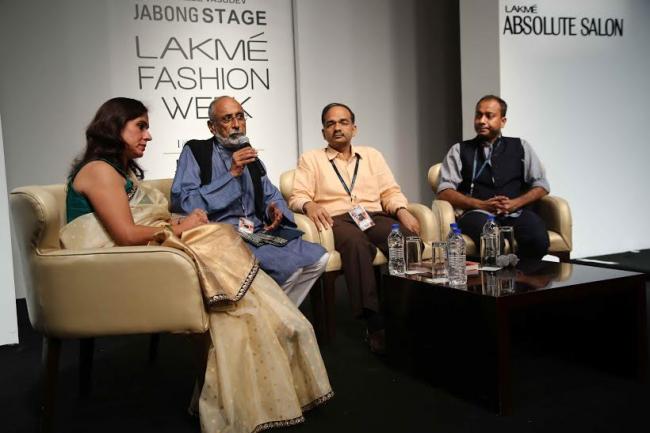
Shefalee Vasudev moderates lively discussion on 'Banaras in Indian Fashion' at LFW Winter/Festive 2015
The panel comprised Sanjay Garg, acclaimed award winning designer; Alok Kumar, Development Commissioner Handlooms, Ministry of Textiles, Government of India; and Ashoke Chatterjee, former Executive Director, National Institute of Design, Ahmedabad.
Shefalee Vasudev kick-started with the questions if fashion was the Root to save, revive, reinvent. What role did modernity play in the textile world and who are the weavers and their future?
Ashoke Chatterjee compared Banaras brocade as the Taj Mahal of Indian craft and the second largest industry after agriculture.
He emphasized helping the old weaves of Varanasi, which are its USP and will change the ground reality of Banaras. Alok Kumar focused on how to win back the trust of the consumers who are interested in genuine handlooms.
He suggested branding/ standardization; developing reliable supply chains for the retailers/ exporters and evolvement of weavers/entrepreneurs. Shefalee queried Sanjay Garg on the authenticity of Benarasi weaves through his collection.
Sanjay Garg responded that handloom was a brand, an emphasis on Khandwa weave, its placement and making, was important along with prices and focus on innovation.
Shefalee questioned ace designer, Ritu Kumar in the audience about her challenges in creating collections and making Banaras weaves as the CSR of her brand. Ritu Kumar stressed on helping the old weaves of Varanasi. Interpreting the weaver’s skills and production of saris for the younger buyers should meet the need of the future generation.
Alok Kumar agreed about products, which are wearable and rooted to traditions for the future generation. The government's association with fashion weeks was to encourage young people and increase demand and opportunities for weavers.
Shefalee asked designer Rohit Bal on his relationship with the weavers. He stated it was a conversation between two artists, and handloom as a labour of love, needed to survive since the country belonged to handloom.
Hemang Agarwal, acclaimed textile designer from Varanasi was positive on the Varanasi focus. He spoke about changes, need for saving the skills and introduced Haji Sahito Rehman, member of the Benarasi weaver community who was also positive about the weaver’s future.
From the audience, designer Urvashi Kaur asserted on the point of preservation of weaving communities and the need to build a valuable aspiration for Banarasi weaves among consumers.
In conclusion Sanjay Garg placed importance on the Varanasi art of handloom and buying power of consumers.
Alok Kumar stressed on sustainable livelihood of the weavers with good remuneration.
Ashoke Chatterjee agreed that consumers needed to be educated about the greatness of handlooms that will not only facilitate revival but also develop other sectors.
Shefalee Vasudev concluded that there was a need for coexistence between the traditional skills and modern opportunities. She suggested that Beti, Kapda and Mukam should be the movement for the revival of Banaras weaves.
Support Our Journalism
We cannot do without you.. your contribution supports unbiased journalism
IBNS is not driven by any ism- not wokeism, not racism, not skewed secularism, not hyper right-wing or left liberal ideals, nor by any hardline religious beliefs or hyper nationalism. We want to serve you good old objective news, as they are. We do not judge or preach. We let people decide for themselves. We only try to present factual and well-sourced news.
Support objective journalism for a small contribution.