


 Nobel Prize
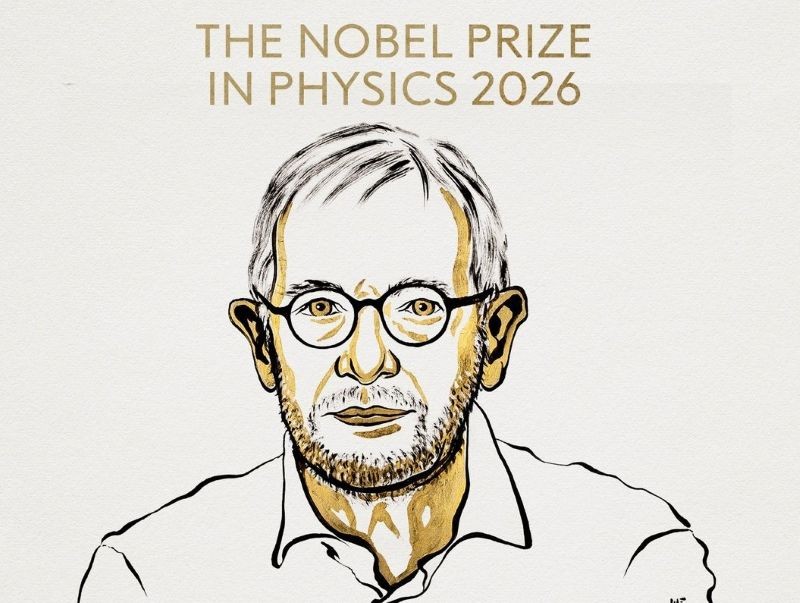
Who is Francis Halzen? Belgian-American physicist wins Nobel Prize in Physics
Belgian-American particle physicist Francis Halzen has won the Nobel Prize in Physics for his “decisive contributions to the IceCube Neutrino Observatory and the discovery of high-energy neutrinos of astrophysical origin”, the award-giving body said.
According to the award-giving body, Halzen realised that the ice at the South Pole could be used to detect and track particles known as neutrinos.
Also Read: Karl Deisseroth wins Nobel Prize: Meet the scientist who changed how we understand the brain
His vision and scientific leadership were fundamental to the development of the IceCube Neutrino Observatory — a cubic-kilometre detector embedded in the Antarctic ice and equipped with thousands of light sensors. Using IceCube, researchers can detect neutrinos produced by extremely energetic processes in the distant universe.
Neutrinos are ubiquitous but extremely difficult to detect. They pass through the Earth and human bodies almost completely unnoticed. Only very rarely does a neutrino interact with an atomic nucleus, producing a signal that can be detected with the right equipment.
Scientists have long known that the universe contains natural particle accelerators capable of producing particles with energies up to a million times greater than those achievable in laboratories on Earth. However, much remains unknown about these cosmic accelerators, including what they are, where they are located and the processes taking place within them.
High-energy neutrinos are produced in the same environments as other energetic particles. Unlike other particles, however, neutrinos can travel vast distances without being deflected or losing significant amounts of energy. This makes them unique messengers that can provide information about the universe that cannot be obtained through other means.
Learn more about the 2026 #NobelPrize in Physics Press release: https://t.co/9uKlq95vbc Popular information: https://t.co/LoXVbnPXNv Advanced information: https://t.co/h8UWBN8sge https://t.co/is6GmdpT9s
— The Nobel Prize (@NobelPrize) October 6, 2026
Halzen first presented his vision of detecting neutrinos at the South Pole in 1988. When a neutrino collides with an atomic nucleus, the interaction produces a flash of light that can be detected by sensors embedded in the clear glacial ice.
The Antarctic ice offers several advantages for such a detector. It is largely free from interference, while the South Pole is geologically stable and experiences no significant earthquake activity. Halzen's proposal soon gained support from other researchers, and preliminary tests using sensors embedded in the ice were conducted within a few years.
Also Read: Karl Deisseroth, Peter Hegemann and Georg Nagel win Nobel Prize in Medicine for optogenetics
Because extremely high-energy cosmic neutrinos are exceptionally rare, researchers need an enormous volume of ice to detect enough interactions. IceCube covers an area equivalent to a cubic kilometre and was completed in 2011.
Researchers soon detected the first high-energy neutrinos, and a few years later published evidence of neutrinos originating from well beyond our solar system. This marked the beginning of a new era in the search for the sources of cosmic neutrinos.
“Francis Halzen has led an international team of researchers and engineers who have provided us with a fantastic instrument. His tenacity and scientific vision has paved the way for a new kind of astronomy,” Mark Pearce, Chair of the Nobel Committee for Physics, said.
The neutrino interactions continuously recorded by IceCube are expected to provide researchers with new insights into the violent cosmic environments where high-energy neutrinos are produced and could potentially help reveal previously unknown astronomical phenomena.
This is the second Nobel Prize to be announced this year, following the Nobel Prize in Physiology or Medicine, which was announced on Monday.
Support Our Journalism
We cannot do without you.. your contribution supports unbiased journalism
IBNS is not driven by any ism- not wokeism, not racism, not skewed secularism, not hyper right-wing or left liberal ideals, nor by any hardline religious beliefs or hyper nationalism. We want to serve you good old objective news, as they are. We do not judge or preach. We let people decide for themselves. We only try to present factual and well-sourced news.
Support objective journalism for a small contribution.


