 Green Propulsion
India commits ₹116 crore to Manastu Space for indigenous green propulsion technology
The Indian government has committed ₹116 crore to Navi Mumbai-based Manastu Space Technologies Private Limited to advance the development of indigenous green propulsion technology for satellites and launch vehicles.
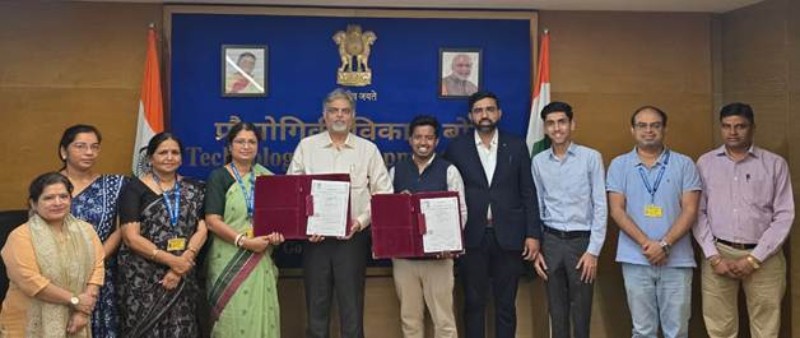
The Technology Development Board (TDB), operating under the Department of Science and Technology (DST), has signed an agreement with the company to provide financial assistance through the Research, Development and Innovation (RDI) Fund.
The project, estimated to cost ₹277.63 crore, aims to develop a scalable, integrated propulsion system capable of operating across a thrust range of 5 millinewtons (mN) to 300 newtons (N).
According to the Ministry of Science and Technology, the funding will be provided through Optionally Convertible Debt (OCD).
The initiative seeks to advance the technology from Technology Readiness Level (TRL) 6 to TRL 9, covering further engineering, system integration, testing, validation and preparation for wider deployment.
Focus on hydrogen peroxide-based propulsion
Manastu Space is developing an indigenous propulsion system that uses a hydrogen peroxide-based green propellant with additives, supported by an integrated engine and catalyst system.
The technology aims to improve performance, operational safety and cost efficiency while addressing some of the challenges associated with conventional propulsion systems.
A key feature is its scalable architecture, which is designed to support a broad range of applications, from small satellites to higher-thrust propulsion requirements for launch vehicles.
The project will involve developing propulsion engines, propellant feed systems and an ultra-high-temperature ceramic catalyst.
These components are intended to support reliable performance under demanding operating conditions.
Technology moves towards wider deployment
The propulsion technology has already been demonstrated in space, according to the project details.
The next stage will focus on further engineering, integration, testing and validation to improve reliability and prepare the system for wider use.
The planned progression from TRL 6 to TRL 9 represents the project's objective of advancing the technology towards deployment readiness.
The initiative comes amid growing demand for propulsion systems that combine operational reliability, cost efficiency and improved safety as India's space sector expands.
Classified under the deep technology sector, with space technology as its sub-sector, the project is also intended to strengthen domestic manufacturing and technological capabilities in a critical area of the space industry.
By developing an indigenous propulsion platform, the initiative aims to reduce India's dependence on imported propulsion technologies for satellite and launch vehicle applications.
TDB highlights strategic importance
TDB Secretary Rajesh Kumar Pathak said indigenous propulsion systems were important for strengthening India's capabilities throughout the space value chain.
“Indigenous propulsion technologies are important for strengthening India’s capabilities across the space value chain. As the country’s space ecosystem continues to expand, there is a growing need for propulsion systems that combine performance, reliability, operational safety and cost efficiency,” Pathak said.
He said the RDI Fund was supporting technology-intensive programmes that required sustained investment to progress from advanced development towards deployment.
“Through the RDI Fund, TDB is supporting technology-intensive programmes that require sustained investment to progress from advanced development towards deployment. The project with Manastu Space reflects this commitment to advancing indigenous space technologies and enabling more sustainable approaches to access to space,” Pathak added.
The financial assistance is intended to support the further development and validation of the company's propulsion platform as it moves towards a higher level of technological readiness.
Manastu Space targets commercial readiness
The co-founder and chief technology officer of Manastu Space Technologies said the funding would help accelerate the development of the company's green propulsion platform and its progress towards commercial readiness.
“The support from TDB under the RDI Fund will help us advance our green propulsion technology through further development, integration and validation. Our objective is to develop a scalable propulsion platform that combines performance, reliability and cost efficiency while addressing the need for safer and more sustainable propellant systems,” the company official said.
The official added that the partnership would support the company's efforts to advance the technology towards TRL 9.
“This partnership will support our efforts to take the technology towards TRL-9 and strengthen India’s indigenous space propulsion capabilities,” the official said.
The project forms part of wider efforts to develop India's domestic space technology ecosystem and advance sustainable propulsion solutions for future satellite and launch vehicle missions.
Support Our Journalism
We cannot do without you.. your contribution supports unbiased journalism
IBNS is not driven by any ism- not wokeism, not racism, not skewed secularism, not hyper right-wing or left liberal ideals, nor by any hardline religious beliefs or hyper nationalism. We want to serve you good old objective news, as they are. We do not judge or preach. We let people decide for themselves. We only try to present factual and well-sourced news.
Support objective journalism for a small contribution.