 QNu Labs
India achieves Quantum breakthrough: QNu Labs demonstrates 5.56-km secure communication link
QNu Labs, in collaboration with the Bhaskaracharya National Institute for Space Applications and Geo-Informatics (BISAG-N) and IIT Gandhinagar, has demonstrated what it describes as India’s first free-space Quantum Key Distribution (QKD) link over a distance of 5.56 km.
The field trial, conducted on the night of September 27–28, established a secure quantum communication channel between BISAG-N and IIT Gandhinagar. Using QNu Labs’ Pointing, Acquisition and Tracking (PAT) system, the trial achieved a stable Quantum Bit Error Rate (QBER) of below 5% and generated secure keys at a rate of 230–260 bits per second (bps).
According to a government statement, the generated keys were integrated with BISAG-N’s post-quantum cryptography-enabled Vedic Kavach platform, enabling successful end-to-end encryption and decryption of test messages.
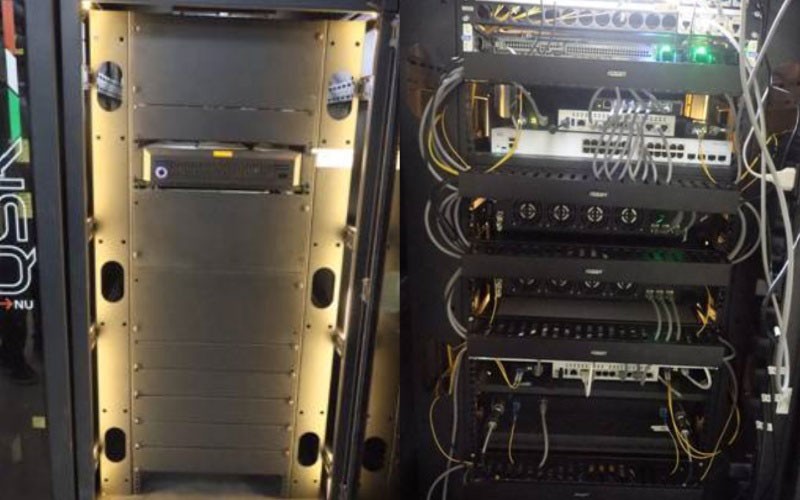
The demonstration combined two complementary layers of quantum security: QNu Labs’ hardware-based QKD system, Armos, operating over free-space optical channels, and BISAG-N’s software-based Vedic Kavach platform, which uses post-quantum cryptography and quantum random number generation.
Startup supported by DST under NQM demonstrates 500 km Quantum-Safe Network
— PIB India (@PIB_India) November 5, 2025
One of the 8 startups supported under the National Quantum Mission (NQM) of the Department of Science and Technology (DST) has successfully demonstrated India's first extensive Quantum Key Distribution… pic.twitter.com/9ZxUutO0VA
The integrated architecture is designed to maintain secure communications even if the physical quantum channel becomes temporarily unavailable.
Dr Vinay Thakur, Director General of BISAG-N, said the integration of Vedic Kavach with QNu Labs’ QKD technology marks a significant step towards developing practical quantum-resilient communication systems.
Sunil Gupta, Co-founder and CEO of QNu Labs, said the successful 5.56-km demonstration could pave the way for longer-distance quantum-secure networks and satellite-based quantum communication.
Cmde Manish Tripathi (Retd.), In-charge of the Indian Space Technology and Future (ISTF) programme at IIT Gandhinagar, said the demonstration provides a valuable field environment for advancing practical quantum communication technologies. He added that it showcases how academia, indigenous technology and real-world experimentation can be brought together to address emerging secure communication requirements.
The trial provides a foundation for further development of India’s secure communication infrastructure and could contribute to strengthening resilience against emerging security threats in the quantum era.
Support Our Journalism
We cannot do without you.. your contribution supports unbiased journalism
IBNS is not driven by any ism- not wokeism, not racism, not skewed secularism, not hyper right-wing or left liberal ideals, nor by any hardline religious beliefs or hyper nationalism. We want to serve you good old objective news, as they are. We do not judge or preach. We let people decide for themselves. We only try to present factual and well-sourced news.
Support objective journalism for a small contribution.