


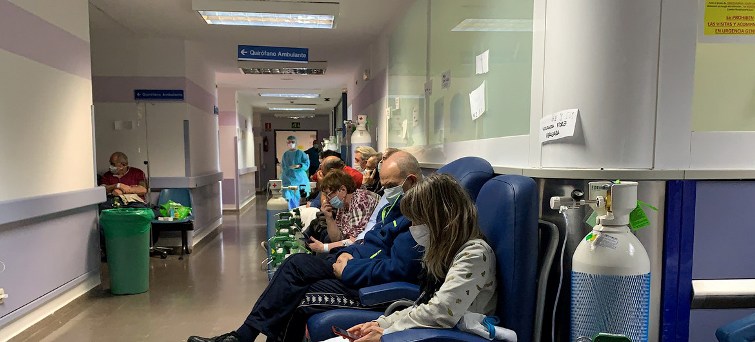
Welcoming early results on use of dexamethasone in sickest COVID-19 patients, WHO warns it’s ‘no cure-all’
New York/IBNS: The UN World Health Organization (WHO) on Wednesday hailed news from the United Kingdom that a common steroid, dexamethasone, can potentially help save the lives of patients with severe cases of COVID-19, but it warned that it is by no means a cure-all.
Early findings suggest that, for hospitalized coronavirus patients on oxygen, dexamethasone – a low-cost prescription anti-inflammatory drug that is available worldwide – can reduce COVID-19 mortality by about one-fifth.
For those on ventilators, mortality is reduced by one-third, according to a University of Oxford team of researchers that compared about 2,000 patients treated with the steroid with 4,000 who were not.
“This is very welcome news for those patients with severe illness,” said WHO Director-General Tedros Adhanom Ghebreyesus during a virtual media briefing from Geneva.
But he emphasized that dexamethasone was shown to have no beneficial effect for those with milder symptoms who do not need respiratory support.
“These drugs should only be used under close clinical supervision,” he said, as the WHO put the number of COVID-19 fatalities worldwide at 434,796 as of Tuesday out of more than reported 7.94 million cases.
Michael Ryan, Executive Director of the WHO’s Health Emergencies Programme, said the WHO is waiting for further details before it can draw up clinical guidelines to share with public health authorities around the world.
“This is not for mild cases. This is not for prophylaxis,” Dr. Ryan said, warning that dexamethasone is associated with viral replication.
Its potential for dealing with COVID-19 is just one of many breakthroughs that must be achieved on the road to effectively defeating the virus, he added.
Through the WHO’s global research and innovation forum on COVID-19, hundreds of researchers from around the world are racing to come up with quality diagnostics, therapeutics and vaccines for the coronavirus.
One of its priorities is to investigate the potential of existing medicines like dexamethasone and remdesivir, a relatively new Ebola drug that appears to reduce the duration of coronavirus symptoms from 15 days to 11 days.
While COVID-19 is touching every corner of the world, Mr. Tedros stressed the need to remain focused as well on essential public health concerns such as malaria, tuberculosis and HIV-AIDS.
In that regard, he announced that the UN health agency and its partners have come up with a fresh roadmap for an integrated approach to neglected tropical diseases – a category that includes 20 diseases including elephantiasis, sleeping sickness, leprosy, trachoma and intestinal worms.
“These diseases disfigure, disable and can kill,” he said, “and they strike hardest in places of poverty and in remote areas where access to quality health services is extremely limited.”
Fielding journalists’ questions, Mr. Tedros noted the speed at which COVID-19 has spread across the planet, from 85,000 cases reported in the first two months of the pandemic to six million since mid-April.
Solidarity needed to combat virus, a “fast-moving killer”
“This virus is very dangerous. It moves fast and it’s a killer,” the Director-General said, adding: “Only by moving faster can we defeat it - and that requires unity and solidarity.”
Dr. Ryan said that the outbreak in Brazil – the hardest-hit nation in Latin America, with 867,624 cases and 43,332 fatalities as of Tuesday – said there are signs that the situation is stablizing.
But he warned that “it is (still) a moment of extreme caution” and urged Brazilians to double down and stay focused on social distancing, personal hygiene and supporting vulnerable groups including minority communities and the poor.
Maria Van Kerkhove, the WHO’s technical lead on the COVID-19 pandemic, meanwhile said that governments must depend on solid data in determining how, when and where to ease restrictions on movement and public gatherings – and to be ready to reinstate them, hopefully temporarily.
Support Our Journalism
We cannot do without you.. your contribution supports unbiased journalism
IBNS is not driven by any ism- not wokeism, not racism, not skewed secularism, not hyper right-wing or left liberal ideals, nor by any hardline religious beliefs or hyper nationalism. We want to serve you good old objective news, as they are. We do not judge or preach. We let people decide for themselves. We only try to present factual and well-sourced news.
Support objective journalism for a small contribution.