


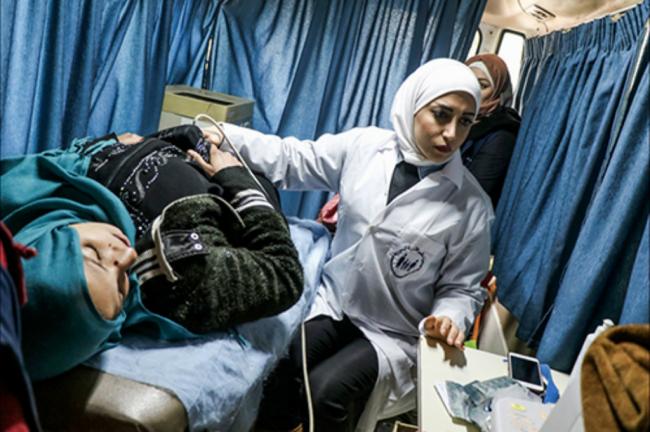
UN agency's mobile reproductive health teams reach women in besieged area of Aleppo
New York, Jan 4 (JEN) The United Nations reproductive rights agency has reached the Sheikh Maqsoud area of Aleppo, where thousands of women have been cut off from medical care for years.
The UN Population Fund (UNFPA) said its mobile reproductive teams reached the area on 30 December, providing family planning services, and antenatal and postpartum care to more than 80 women.
“Conflict typically puts these women and their babies at risk. Physical hardship and emotional trauma often complicate delivery,” said Massimo Diana, UNFPA's Representative in Syria. “Health services are deteriorated after the seven years of crisis in Syria, in addition to the limited supplies and high patient loads.”
One health facility is operational in Sheikh Maqsoud, serving an estimated 50 patients per day. According to UNFPA that is “not sufficient to meet local needs, where about 3,000 women are estimated to be pregnant.”
The UN agency said the existing health facility is poorly equipped, with no capacity to perform Caesarean section operations or other major surgeries. There is no ambulance available to transfer critical cases to hospitals outside the area.
Humanitarian responders also noted that most roads are in disrepair and choked with mud, limiting access. The area also lacks an operating electrical system, forcing the community to rely on generators and expensive fuel, when available.
In addition to lacking quality reproductive health care, humanitarian workers observed a large number of people living with disabilities, including wheelchair users, as well as families in desperate need of warm clothing for the winter.
Photo: UNFPA Syria
Support Our Journalism
We cannot do without you.. your contribution supports unbiased journalism
IBNS is not driven by any ism- not wokeism, not racism, not skewed secularism, not hyper right-wing or left liberal ideals, nor by any hardline religious beliefs or hyper nationalism. We want to serve you good old objective news, as they are. We do not judge or preach. We let people decide for themselves. We only try to present factual and well-sourced news.
Support objective journalism for a small contribution.


