


New 3D vision discovered in praying mantis
London, Feb 9 (IBNS): Miniature glasses have revealed a new form of 3D vision in praying mantises that could lead to simpler visual processing for robots.
Publishing their latest research in Current Biology, the Newcastle University team have discovered that mantis 3D vision works differently from all previously known forms of biological 3D vision.
3D or stereo vision helps us work out the distances to the things we see. Each of our eyes sees a slightly different view of the world. Our brains merge these two views to create a single image, while using the differences between the two views to work out how far away things are.
But humans are not the only animals that have stereo vision. Other animals include monkeys, cats, horses, owls and toads, but the only insect known to have stereo vision is the praying mantis.
Going bug-eyed?
A team at the Institute of Neuroscience at Newcastle University funded by the Leverhulme Trust have been investigating whether praying mantis 3D vision works in the same way as humans’.
To investigate this they created special insect 3D glasses which were temporarily glued on with beeswax.
In their insect 3D cinema, they could show the mantis a movie of tasty prey, apparently hovering right in front of the mantis. The illusion is so good the mantises try to catch it.
The scientists could now show the mantises not only simple movies of bugs, but the complex dot-patterns used to investigate human 3D vision. This enabled them to compare human and insect 3D vision for the first time.
Humans are incredibly good at seeing 3D in still images. We do this by matching up the details of the picture seen in each eye. But mantises only attack moving prey so their 3D doesn’t need to work in still images. The team found mantises don’t bother about the details of the picture but just look for places where the picture is changing.
This makes mantis 3D vision very robust. Even if the scientists made the two eyes’ images completely different, mantises can still match up the places where things are changing. They did so even when humans couldn’t.
It's a bugs life
“This is a completely new form of 3D vision as it is based on change over time instead of static images,” said behavioural ecologist, Dr Vivek Nityananda at Newcastle University. “In mantises it is probably designed to answer the question ‘is there prey at the right distance for me to catch?’”
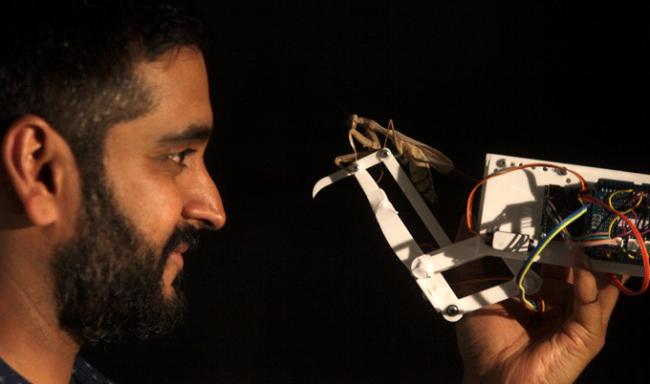
As part of the wider research, a Newcastle University engineering student developed an electronic mantis arm which mimics the distinct striking action of the insect.
Fellow team-member from the School of Engineering, Dr Ghaith Tarawneh adds, “Many robots use stereo vision to help them navigate, but this is usually based on complex human stereo. Since insect brains are so tiny, their form of stereo vision can’t require much computer processing. This means it could find useful applications in low-power autonomous robots.”
Image: Newcastle University website
Support Our Journalism
We cannot do without you.. your contribution supports unbiased journalism
IBNS is not driven by any ism- not wokeism, not racism, not skewed secularism, not hyper right-wing or left liberal ideals, nor by any hardline religious beliefs or hyper nationalism. We want to serve you good old objective news, as they are. We do not judge or preach. We let people decide for themselves. We only try to present factual and well-sourced news.
Support objective journalism for a small contribution.


