


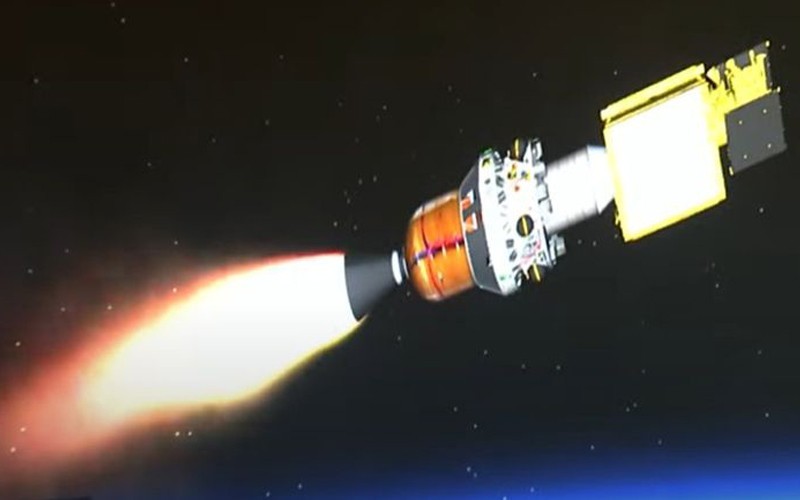
Against all odds, ‘KID’ survives failed PSLV-C62 mission, sends data back to Earth
Sometimes, getting the job done requires sheer, child-like tenacity—and KID appears to have delivered exactly that. While Monday’s PSLV-C62 mission was declared a failure after ISRO confirmed the loss of its primary payloads, a small capsule aboard the rocket has emerged as an unlikely survivor.
Spanish startup Orbital Paradigm revealed on Tuesday that its Kestrel Initial Demonstrator (KID) capsule not only successfully separated from the launch vehicle but also powered on and transmitted data, defying expectations after the mission went awry.
The announcement came a day after it was widely believed that the PSLV’s entire payload—including the strategic Anvesha surveillance satellite—had been lost.
“Our KID capsule, against all odds, separated from PSLV-C62, switched on, and transmitted data. We’re reconstructing trajectory. Full report will come,” Orbital Paradigm posted on X.
Our KID capsule, against all odds, separated from PSLV C62, switched on, and transmitted data. We're reconstructing trajectory. Full report will come. [Edited from previous version]
— Orbital Paradigm (@OrbitalParadigm) January 13, 2026
The company underscored the near-miraculous nature of the feat, particularly given the extreme conditions during launch anomalies.
The KID capsule was a technology demonstrator, designed to test systems critical for atmospheric re-entry.
KID is a prototype for the firm’s planned commercial vehicle, Kernel, which is expected to return up to 120 kg of cargo from orbit—an emerging market that could significantly lower costs for space-to-Earth logistics.
‘Lost’ satellites and a failed mission
The PSLV-C62 was carrying 15 satellites in total. These included the EOS-N1 earth observation satellite, the Anvesha surveillance satellite developed by DRDO, the AyulSat tanker satellite, payloads from Dhruva Space, and several student-built satellites.
Anvesha was designed to strengthen India’s defence surveillance capabilities by providing high-resolution imaging to track enemy movement and deployments.
What went wrong
The mission, ISRO’s first launch of 2026, lifted off from Sriharikota at 10:18 am. According to ISRO Chairman V Narayanan, the launch proceeded normally through the first two stages.
“Disturbances in the rocket and later deviation from the flight path were observed when strap-on motors were providing thrust during the flight’s third stage,” he said, adding that the anomaly prevented the vehicle from reaching the intended orbit.
Why KID’s survival matters
Orbital Paradigm co-founder and CEO Francesco Cacciatore had earlier said that KID’s mission was aimed at advancing the company’s understanding of atmospheric re-entry, a phase that cannot be fully replicated in ground testing.
“Unlike other mission phases, there is no way to accurately reproduce on Earth all the conditions encountered during re-entry,” he wrote ahead of the launch.
While PSLV-C62 will be remembered as a failed mission for ISRO, KID’s unexpected success offers a rare bright spot—and valuable data—for the future of space-to-Earth return technologies.
Support Our Journalism
We cannot do without you.. your contribution supports unbiased journalism
IBNS is not driven by any ism- not wokeism, not racism, not skewed secularism, not hyper right-wing or left liberal ideals, nor by any hardline religious beliefs or hyper nationalism. We want to serve you good old objective news, as they are. We do not judge or preach. We let people decide for themselves. We only try to present factual and well-sourced news.
Support objective journalism for a small contribution.


