


ISRO carries out technology demonstration to qualify Crew Escape System
Sriharikota, Jul 5 (IBNS): ISRO has carried out a major technology demonstration, the first in a series of tests to qualify a Crew Escape System, which is a critical technology relevant for human spaceflight.
The Crew Escape System is an emergency escape measure designed to quickly pull the crew module along with the astronauts to a safe distance from the launch vehicle in the event of a launch abort.
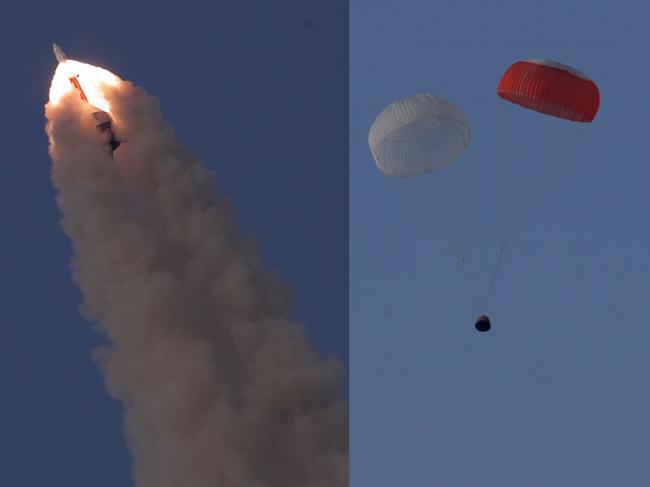
The first test (Pad Abort Test) demonstrated the safe recovery of the crew module in case of any exigency at the launch pad.
After a smooth countdown of five hours, the Crew Escape System along with the simulated crew module with a mass of 12.6 tonnes, lifted off at 7 am IST at the opening of the launch window from its pad at Satish Dhawan Space Centre, Sriharikota on Thursday.
The test was over in 259 seconds, during which the Crew Escape System along with crew module soared skyward, then arced out over the Bay of Bengal and floated back to Earth under its parachutes about 2.9 km from Sriharikota.
The crew module reached an altitude of nearly 2.7 km under the power of its seven specifically designed quick acting solid motors to take away the crew module to a safe distance without exceeding the safe g-levels.
Nearly 300 sensors recorded various mission performance parameters during the test flight.
Three recovery boats are being exercised to retrieve the module as part of the recovery protocol.
Support Our Journalism
We cannot do without you.. your contribution supports unbiased journalism
IBNS is not driven by any ism- not wokeism, not racism, not skewed secularism, not hyper right-wing or left liberal ideals, nor by any hardline religious beliefs or hyper nationalism. We want to serve you good old objective news, as they are. We do not judge or preach. We let people decide for themselves. We only try to present factual and well-sourced news.
Support objective journalism for a small contribution.


