


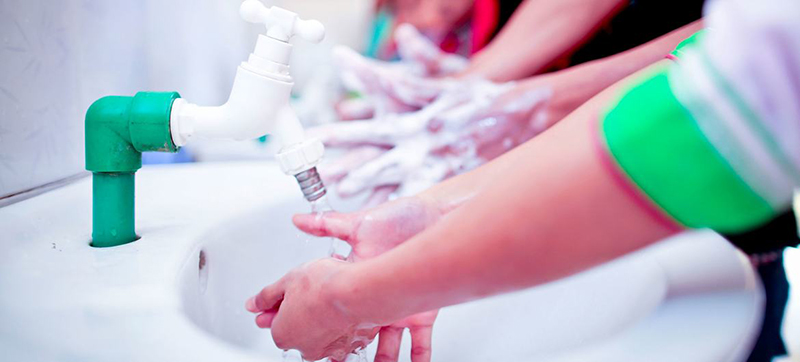
 Clean Hands
Clean hands may make the difference between life and death – WHO report
New York: When good hand hygiene and other infection prevention and control (IPC) measures are followed, 70 per cent of infections can be prevented in health care settings, according to a new World Health Organization (WHO) report published on Friday.
The coronavirus pandemic and other disease outbreaks have highlighted the extent to which healthcare settings can contribute to the spread of infections.
“The COVID-19 pandemic has exposed many challenges and gaps in IPC in all regions and countries, including those which had the most advanced IPC programmes,” said Tedros Adhanom Ghebreyesus, WHO Director General.
‘An unprecedented opportunity’
Today, out of every 100 patients in acute care hospitals, seven in high-income countries and 15 in low and middle-income nations will acquire at least one healthcare associated infection (HAI) during their hospital stay – one in 10 of whom will die.
Newborns and patients in intensive care are particularly at risk, the report reveals, and almost half of all sepsis cases with organ dysfunction in adult intensive-care units are linked to healthcare.
WHO’s first-ever Global Report on Infection Prevention and Control brings together evidence from scientific reports, and new data from WHO studies.
“It has also provided an unprecedented opportunity to take stock of the situation and rapidly scale up outbreak readiness and response through IPC practices, as well as strengthening IPC programmes across the health system,” said the WHO chief.
Making a case
The impact of healthcare linked infections and antimicrobial resistance on people’s lives is incalculable, says WHO.
Over 24 per cent of patients affected by health care-associated sepsis and 52.3 per cent of those treated in an intensive care unit die each year.
Moreover, deaths are increased two to threefold when infections are resistant to antimicrobials.
With regional and country focuses, the new WHO report provides a situation analysis of how IPC programmes are being implemented globally.
While addressing the harm that HAIs and antimicrobial resistance pose to patients and healthcare workers, it also highlights the impact and cost-effectiveness of infection prevention and control programmes as well as the strategies and resources available for States to improve them.
Data analysis
In the last five years, WHO conducted global surveys and country joint evaluations to assess the implementation status of national IPC programmes.
Comparing data from the 2017-18 to 2021-22 surveys, the percentage of countries with a national IPC programme did not improve; and in 2021-22, only 3.8 per cent of countries had all IPC minimum requirements in place at the national level.
In healthcare facilities, only 15.2 per cent met all the IPC minimum requirements, according to a 2019 WHO survey.
Our challenge now is to ensure that all countries are able to allocate the human resources, supplies and infrastructures – WHO chief
Heartening developments
However, some encouraging progress has been made, with significantly more countries appointing IPC focal points; dedicated budgets for IPC and curriculum for front line healthcare workers’ training; national IPC guidelines and programmes for HAI surveillance; and hand hygiene compliance established as key national indicators.
Strongly supported by WHO and others, many countries are scaling-up actions to put in place minimum requirements and core components of IPC programmes.
Sustaining and further expanding this progress in the long-term is a critical need that requires urgent attention and investments.
Investments needed
“Our challenge now is to ensure that all countries are able to allocate the human resources, supplies and infrastructures this requires,” said Tedros.
WHO is calling on every nation to boost investments in IPC programmes – not only to protect patients and health workers, but also to improve health outcomes and reduce health-care costs and out-of-pocket expenses.
Support Our Journalism
We cannot do without you.. your contribution supports unbiased journalism
IBNS is not driven by any ism- not wokeism, not racism, not skewed secularism, not hyper right-wing or left liberal ideals, nor by any hardline religious beliefs or hyper nationalism. We want to serve you good old objective news, as they are. We do not judge or preach. We let people decide for themselves. We only try to present factual and well-sourced news.
Support objective journalism for a small contribution.


